Shallot
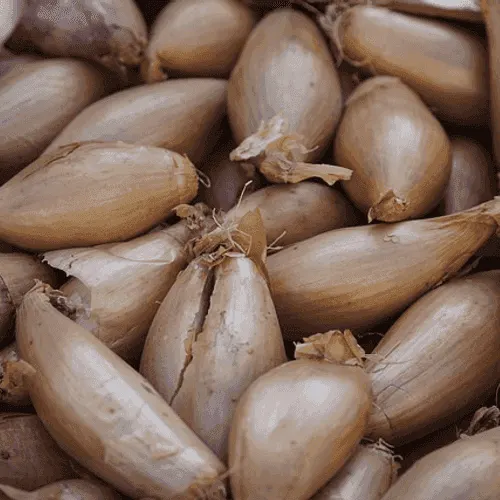
Other names French shallot, eschalot
Shallot: high in FODMAPs and oligosaccharides; moderate in salicylate; low in histamine, fructose, nickel and oxalates. If you're sensitive to any of these, check it against your profile before eating.
Intolerances
- FODMAPsHigh
Shallot is the most concentrated of the alliums in FODMAPs by weight, and it is the one that hides: a restaurant vinaigrette, a sauce, a mignonette. Nobody lists shallot as a main ingredient, and the quantity that flavours a whole dressing is enough.
Sources· 1
- Muir J et al., J Agric Food Chem 55 (2007) 6619-6627 and 57 (2009) 554-565, fructans and short-chain carbohydrates measured in Australian vegetables and fruit
- OligosaccharidesFODMAPsHigh
Same reason as the FODMAP level: shallot fructans, among the most concentrated of the alliums by weight. The quantity that flavours a sauce is enough, which is why this is the one that catches people eating out. Muir measured the fructans in 60 vegetables and put these five at the top — garlic, artichoke, shallot, leek bulb and onion — across a range of 1.2 to 17.4 g per 100 g fresh weight for the group. The paper does not rank them against one another.
Sources· 1
- Muir J.G. et al., J Agric Food Chem 55 (2007) 6619–27 and 57 (2009) 554–65, fructans and short-chain carbohydrates measured in Australian vegetables and fruit
- SalicylateModerate
Shallot runs higher in salicylate than onion, and it is used raw in dressings more often than onion is — raw is where the load is highest.
Sources· 1
- Scotter M.J. et al., Food Chemistry 105 (2007), free and acetyl salicylic acid in foods by GC-MS, and Venema D. et al., J Agric Food Chem 44 (1996), acetylsalicylic and salicylic acid in foods by HPLC
- Histamine (+liberators / DAO inhibitors)Low
Shallot carries no meaningful histamine and does not liberate any. Fresh vegetables are the reliable ground on this axis - it is fermenting them, or letting them sit, that changes the answer.
Sources· 1
- SIGHI — Swiss Interest Group Histamine Intolerance, food-compatibility list, for the entry, its rating and its letters
- FructoseFODMAPsLow
Shallot carries very little free fructose. Its FODMAP problem is fructans - long chains that are a different molecule and a different question from the free sugar measured here.
- NickelLow
Shallots grow as bulbs just under the surface. Like onions and garlic they take up little nickel, and the papery outer layers that hold the most are the ones thrown away. The nickel here follows a survey of heavy metals in VEGETABLES. A vegetable takes up what its soil holds, so a figure of this kind describes the growing region as much as the plant.
Sources· 1
- Guerra F. et al., Scientia Agricola 69:1 (2012) 54-60, heavy metals in vegetables
- OxalatesLow
Shallot is a bulb, and bulbs sit low on this axis - the oxalate of an allium is in the green tops rather than the swollen base. The papery outer layers that carry most are thrown away.
Sources· 1
- Noonan S.C. & Savage G.P., Asia Pac J Clin Nutr 8:1 (1999) 64-74, oxalate content of foods and its effect on humans
- TyramineNone
- SucroseNone
- LactoseFODMAPsNone
- SorbitolFODMAPsNone
- GlutenNo
Intolerance levels are based on our documented scientific sources. See sources →
React to FODMAPs? Check these too
More in Vegetables
 Artichoke
 Artichoke heart
 Bamboo shoots
 Beetroot
 Bitter gourd
 Black beans
 Broccoli
 Brussels sprouts
 Cabbage
 Carrot
 Cassava
 Cauliflower
Frequently asked questions
Which intolerances does shallot affect?
Shallot is notable for FODMAPs, oligosaccharides, salicylate, histamine, fructose, nickel and oxalates. Clear on tyramine, sucrose, lactose, sorbitol and gluten.
Does shallot contain FODMAPs?
Yes — shallot is high in FODMAPs. Shallot is the most concentrated of the alliums in FODMAPs by weight, and it is the one that hides: a restaurant vinaigrette, a sauce, a mignonette. Nobody lists shallot as a main ingredient, and the quantity that flavours a whole dressing is enough.
Does shallot contain oligosaccharides?
Yes — shallot is high in oligosaccharides. Same reason as the FODMAP level: shallot fructans, among the most concentrated of the alliums by weight. The quantity that flavours a sauce is enough, which is why this is the one that catches people eating out. Muir measured the fructans in 60 vegetables and put these five at the top — garlic, artichoke, shallot, leek bulb and onion — across a range of 1.2 to 17.4 g per 100 g fresh weight for the group. The paper does not rank them against one another.
Does shallot contain salicylate?
Shallot contains moderate levels of salicylate. Shallot runs higher in salicylate than onion, and it is used raw in dressings more often than onion is — raw is where the load is highest.
Does shallot contain histamine?
Shallot contains only low levels of histamine. Shallot carries no meaningful histamine and does not liberate any. Fresh vegetables are the reliable ground on this axis - it is fermenting them, or letting them sit, that changes the answer. Amounts vary by brand and recipe, so always check the label of the exact product.
Check any product in seconds
Scan a barcode with the Yllo app and see straight away whether a product fits your intolerances.