Artichoke
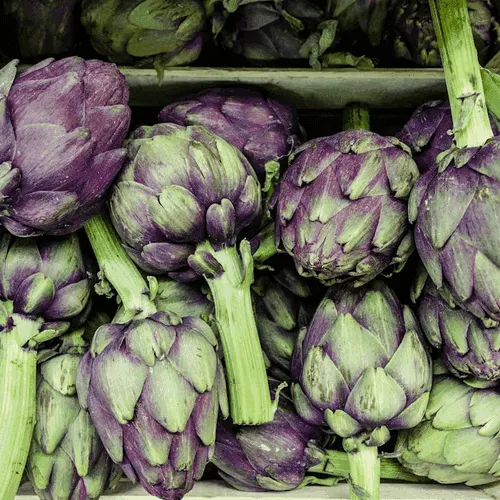
Other names globe artichoke
Artichoke: high in FODMAPs and oligosaccharides; moderate in fructose and salicylate; low in histamine, tyramine, nickel and oxalates. If you're sensitive to any of these, check it against your profile before eating.
Intolerances
- FODMAPsHigh
Artichoke is one of the richest natural sources of inulin, the long fructan that chicory root is farmed for. The globe is eaten leaf by leaf, which spreads the dose over a meal but does not lower it - and boiling does not help, because fructans are water-soluble and most people drink the liquid or eat the heart wet. A separate survey, measuring the three fructooligosaccharide oligomers by ion chromatography, puts it plainly: of the vegetables investigated, artichokes contained by far the most FOS, followed by onions.
Sources· 3
- Muir J et al., J Agric Food Chem 55 (2007) 6619-6627 and 57 (2009) 554-565, fructans and short-chain carbohydrates measured in Australian vegetables and fruit
- Tuck C et al., J Hum Nutr Diet 31 (2018), FODMAP content of common plant-based and processed foods
- Hogarth A.J. et al., J Agric Food Chem 48 (2000) 5326-5330, three fructooligosaccharide oligomers measured by ion chromatography
- OligosaccharidesFODMAPsHigh
Same reason as the FODMAP level: the artichoke stores its reserve as inulin, a long fructan chain, and inulin is the textbook oligosaccharide. It is the plant this whole family of compounds was first isolated from. Muir measured the fructans in 60 vegetables and put these five at the top — garlic, artichoke, shallot, leek bulb and onion — across a range of 1.2 to 17.4 g per 100 g fresh weight for the group. The paper does not rank them against one another.
Sources· 1
- Muir J.G. et al., J Agric Food Chem 55 (2007) 6619–27 and 57 (2009) 554–65, fructans and short-chain carbohydrates measured in Australian vegetables and fruit
- FructoseFODMAPsModerate
Artichoke carries both fructose and fructans, and the fructans are the larger share - which matters because they are not affected by eating glucose alongside, the trick that helps with fructose. The globe is eaten leaf by leaf, so the dose builds slowly and stops when you reach the choke. The fructose and fructan contents are the measured part.
Sources· 2
- L'homme C et al., J Chromatogr A 920 (2001) 291-297, sugars and fructans of artichoke
- Tuck C et al., J Hum Nutr Diet 31 (2018)
- SalicylateModerate
Artichoke: salicylate concentrates in the outer leaves and the tips, so trimming hard and eating mostly the heart brings the level down noticeably.
Sources· 1
- Scotter M.J. et al., Food Chemistry 105 (2007), free and acetyl salicylic acid in foods by GC-MS, and Venema D. et al., J Agric Food Chem 44 (1996), acetylsalicylic and salicylic acid in foods by HPLC
- Histamine (+liberators / DAO inhibitors)Low
Artichoke carries no meaningful histamine and does not liberate any. Fresh vegetables are the reliable ground on this axis - it is fermenting them, or letting them sit, that changes the answer.
Sources· 1
- SIGHI — Swiss Interest Group Histamine Intolerance, food-compatibility list, for the entry, its rating and its letters
- TyramineLow
Artichoke is low. What is eaten is a flower bud, boiled or steamed within days of cutting - nowhere in its life do bacteria get time on protein. The few surveys that measured vegetables for tyramine put the leafy and green ones at the bottom of their range.
Sources· 1
- Ly D. et al., J Med Food 11:2 (2008) 385-389, and Simon-Sarkadi L. et al., Z Lebensm Unters Forsch 198 (1994), tyramine in vegetables
- NickelLow
Artichoke is low in nickel despite being a thistle grown in heavy soil. Most of the plant is discarded - it is the heart and the leaf bases that are eaten. The nickel here follows a survey of heavy metals in VEGETABLES. A vegetable takes up what its soil holds, so a figure of this kind describes the growing region as much as the plant.
Sources· 1
- Guerra F. et al., Scientia Agricola 69:1 (2012) 54-60, heavy metals in vegetables
- OxalatesLow
Artichoke is a thistle, and thistles are the family you would expect to be high - but the part eaten is the flower base and the fleshy leaf ends, not the foliage where oxalate concentrates. Most of the plant is discarded before it reaches the plate.
Sources· 1
- Noonan S.C. & Savage G.P., Asia Pac J Clin Nutr 8:1 (1999) 64-74, oxalate content of foods and its effect on humans
- LactoseFODMAPsNone
- GlutenNone
- SorbitolFODMAPsNone
- SucroseNone
Intolerance levels are based on our documented scientific sources. See sources →
Note about this food
The HIGH rating for FODMAPs applies to typical serving sizes (½ cup/75g). Smaller portions (⅓ cup/50g) are low FODMAP . Canned/jarred artichoke hearts in brine are specifically recommended for low FODMAP diets Fructose: this vegetable contains fructose and fructans that can trigger symptoms in fructose malabsorption, but it is dose-dependent, so a small portion is often tolerated. Eating it with a glucose source improves fructose absorption.
React to FODMAPs? Check these too
More in Vegetables
 Artichoke heart
 Bamboo shoots
 Beetroot
 Bitter gourd
 Black beans
 Broccoli
 Brussels sprouts
 Cabbage
 Carrot
 Cassava
 Cauliflower
 Celery
Frequently asked questions
Which intolerances does artichoke affect?
Artichoke is notable for FODMAPs, oligosaccharides, fructose, salicylate, histamine, tyramine, nickel and oxalates. Clear on lactose, gluten, sorbitol and sucrose.
Does artichoke contain FODMAPs?
Yes — artichoke is high in FODMAPs. Artichoke is one of the richest natural sources of inulin, the long fructan that chicory root is farmed for. The globe is eaten leaf by leaf, which spreads the dose over a meal but does not lower it - and boiling does not help, because fructans are water-soluble and most people drink the liquid or eat the heart wet. A separate survey, measuring the three fructooligosaccharide oligomers by ion chromatography, puts it plainly: of the vegetables investigated, artichokes contained by far the most FOS, followed by onions.
Does artichoke contain oligosaccharides?
Yes — artichoke is high in oligosaccharides. Same reason as the FODMAP level: the artichoke stores its reserve as inulin, a long fructan chain, and inulin is the textbook oligosaccharide. It is the plant this whole family of compounds was first isolated from. Muir measured the fructans in 60 vegetables and put these five at the top — garlic, artichoke, shallot, leek bulb and onion — across a range of 1.2 to 17.4 g per 100 g fresh weight for the group. The paper does not rank them against one another.
Does artichoke contain fructose?
Artichoke contains moderate levels of fructose. Artichoke carries both fructose and fructans, and the fructans are the larger share - which matters because they are not affected by eating glucose alongside, the trick that helps with fructose. The globe is eaten leaf by leaf, so the dose builds slowly and stops when you reach the choke. The fructose and fructan contents are the measured part.
Does artichoke contain salicylate?
Artichoke contains moderate levels of salicylate. Artichoke: salicylate concentrates in the outer leaves and the tips, so trimming hard and eating mostly the heart brings the level down noticeably. Amounts vary by brand and recipe, so always check the label of the exact product.
Check any product in seconds
Scan a barcode with the Yllo app and see straight away whether a product fits your intolerances.