Onion
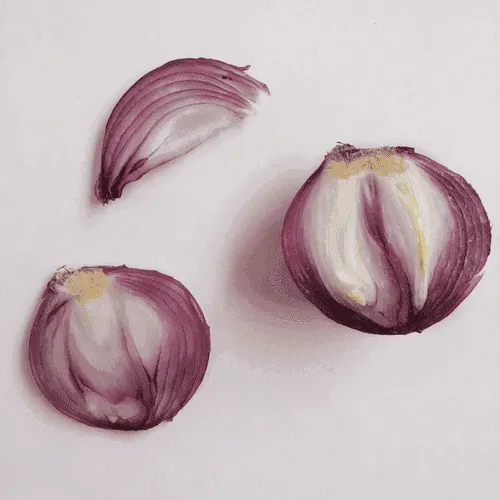
Onion: high in FODMAPs and oligosaccharides; low in salicylate and fructose. If you're sensitive to any of these, check it against your profile before eating.
Intolerances
- FODMAPsHigh
Onion carries mostly GF2 - a short fructan chain of three units - concentrated in the fleshy layers rather than the papery ones. Short chains ferment fast, which is why onion acts quickly rather than hours later. Long browning does break some of it, since dry heat above about 135 degrees degrades fructan, but not reliably enough to make fried onion a safe form: what is left is concentrated by the water that boiled off. Two things were measured on the onion itself. Across Sturon, Hysam, Durco and Caribo, fructans are the main carbohydrate and the SHORTEST oligomer is the major one - which is what makes onion fructan so readily fermented. And STORAGE changes it: free fructose rises markedly over months in store, attributed to the fructans hydrolysing. The fifth variety, Grano de Oro, is simply different - low fructan and FOS, high reducing sugars - so a low-fructan onion is a real thing, just not one a label tells you about. One figure puts this in proportion, and it is about the diet rather than the plant: in a survey of more than 15,000 Americans, WHEAT SUPPLIED ABOUT 70 PER CENT of all the inulin and oligofructose eaten, and onions about 25 - two foods for roughly 95 per cent of the total, against a daily average of 2.6 g of inulin and 2.5 g of oligofructose. That share belongs to a particular cuisine, not to the crop: a diet built on chicory or artichoke would divide differently. A separate survey, measuring the three fructooligosaccharide oligomers by ion chromatography, places the onion second of the vegetables it investigated - behind the artichoke and ahead of everything else it measured.
Sources· 4
- Muir J et al., J Agric Food Chem 55 (2007) 6619-6627 and 57 (2009) 554-565, fructans and short-chain carbohydrates measured in Australian vegetables and fruit
- Jaime L. et al., J Agric Food Chem 49:2 (2001) 982-988, fructan and fructooligosaccharide of onion through storage
- Moshfegh A.J. et al., J Nutr 129:7 Suppl (1999) 1407S-1411S, inulin and oligofructose in the diets of Americans
- Hogarth A.J. et al., J Agric Food Chem 48 (2000) 5326-5330, three fructooligosaccharide oligomers measured by ion chromatography
- OligosaccharidesFODMAPsHigh
Onion carries mostly GF2 - three units, about as short as a chain gets while still counting. Short chains ferment quickly, which is why onion produces symptoms faster than the long-chain inulin in a fibre supplement does. Muir measured the fructans in 60 vegetables and put these five at the top — garlic, artichoke, shallot, leek bulb and onion — across a range of 1.2 to 17.4 g per 100 g fresh weight for the group. The paper does not rank them against one another. One figure puts this in proportion, and it is about the diet rather than the plant: in a survey of more than 15,000 Americans, WHEAT SUPPLIED ABOUT 70 PER CENT of all the inulin and oligofructose eaten, and onions about 25 - two foods for roughly 95 per cent of the total, against a daily average of 2.6 g of inulin and 2.5 g of oligofructose. That share belongs to a particular cuisine, not to the crop: a diet built on chicory or artichoke would divide differently.
Sources· 2
- Muir J.G. et al., J Agric Food Chem 55 (2007) 6619–27 and 57 (2009) 554–65, fructans and short-chain carbohydrates measured in Australian vegetables and fruit
- Moshfegh A.J. et al., J Nutr 129:7 Suppl (1999) 1407S-1411S, inulin and oligofructose in the diets of Americans
- SalicylateLow
Onion measures 5.0 mg of salicylate per kilogram for the white variety and 12.9 for the spanish - the variety matters more here than on most foods, and the survey measured both. A 36 g serve of white onion carries 0.18 mg.
Sources· 1
- Malakar S, Gibson PR, Barrett JS & Muir JG, J Food Compos Anal 57 (2017), 31-39 - salicylic acid measured by GC-MS in 112 common foods, reported per serve as well as per kilogram
- FructoseFODMAPsLow
Onion carries free fructose, and how much depends on how long it has been stored: a study of five varieties found that storage raises free fructose markedly, as the onion's own fructans break down into it. An onion out of long storage is therefore not the same food on this axis as a freshly lifted one. Four of the five had fructans as their main carbohydrate, and Grano de Oro was the exception — low in fructans and high in reducing sugars from the start — so the variety matters as much as the age.
Sources· 1
- Jaime L. et al. (2001), five onion varieties and what storage does to their fructan and fructo-oligosaccharide content — a direction of change and the varieties it was seen in, with no milligrams per 100 g for any of them
- Histamine (+liberators / DAO inhibitors)None
- TyramineNone
- SucroseNone
- LactoseFODMAPsNone
- SorbitolFODMAPsNone
- NickelNone
- OxalatesNone
- GlutenNo
Intolerance levels are based on our documented scientific sources. See sources →
React to FODMAPs? Check these too








More in Vegetables
 Artichoke
 Artichoke heart
 Bamboo shoots
 Beetroot
 Bitter gourd
 Black beans
 Broccoli
 Brussels sprouts
 Cabbage
 Carrot
 Cassava
 Cauliflower
Frequently asked questions
Which intolerances does onion affect?
Onion is notable for FODMAPs, oligosaccharides, salicylate and fructose. Clear on histamine, tyramine, sucrose, lactose, sorbitol, nickel, oxalates and gluten.
Does onion contain FODMAPs?
Yes — onion is high in FODMAPs. Onion carries mostly GF2 - a short fructan chain of three units - concentrated in the fleshy layers rather than the papery ones. Short chains ferment fast, which is why onion acts quickly rather than hours later. Long browning does break some of it, since dry heat above about 135 degrees degrades fructan, but not reliably enough to make fried onion a safe form: what is left is concentrated by the water that boiled off. Two things were measured on the onion itself. Across Sturon, Hysam, Durco and Caribo, fructans are the main carbohydrate and the SHORTEST oligomer is the major one - which is what makes onion fructan so readily fermented. And STORAGE changes it: free fructose rises markedly over months in store, attributed to the fructans hydrolysing. The fifth variety, Grano de Oro, is simply different - low fructan and FOS, high reducing sugars - so a low-fructan onion is a real thing, just not one a label tells you about. One figure puts this in proportion, and it is about the diet rather than the plant: in a survey of more than 15,000 Americans, WHEAT SUPPLIED ABOUT 70 PER CENT of all the inulin and oligofructose eaten, and onions about 25 - two foods for roughly 95 per cent of the total, against a daily average of 2.6 g of inulin and 2.5 g of oligofructose. That share belongs to a particular cuisine, not to the crop: a diet built on chicory or artichoke would divide differently. A separate survey, measuring the three fructooligosaccharide oligomers by ion chromatography, places the onion second of the vegetables it investigated - behind the artichoke and ahead of everything else it measured.
Does onion contain oligosaccharides?
Yes — onion is high in oligosaccharides. Onion carries mostly GF2 - three units, about as short as a chain gets while still counting. Short chains ferment quickly, which is why onion produces symptoms faster than the long-chain inulin in a fibre supplement does. Muir measured the fructans in 60 vegetables and put these five at the top — garlic, artichoke, shallot, leek bulb and onion — across a range of 1.2 to 17.4 g per 100 g fresh weight for the group. The paper does not rank them against one another. One figure puts this in proportion, and it is about the diet rather than the plant: in a survey of more than 15,000 Americans, WHEAT SUPPLIED ABOUT 70 PER CENT of all the inulin and oligofructose eaten, and onions about 25 - two foods for roughly 95 per cent of the total, against a daily average of 2.6 g of inulin and 2.5 g of oligofructose. That share belongs to a particular cuisine, not to the crop: a diet built on chicory or artichoke would divide differently.
Does onion contain salicylate?
Onion contains only low levels of salicylate. Onion measures 5.0 mg of salicylate per kilogram for the white variety and 12.9 for the spanish - the variety matters more here than on most foods, and the survey measured both. A 36 g serve of white onion carries 0.18 mg.
Does onion contain fructose?
Onion contains only low levels of fructose. Onion carries free fructose, and how much depends on how long it has been stored: a study of five varieties found that storage raises free fructose markedly, as the onion's own fructans break down into it. An onion out of long storage is therefore not the same food on this axis as a freshly lifted one. Four of the five had fructans as their main carbohydrate, and Grano de Oro was the exception — low in fructans and high in reducing sugars from the start — so the variety matters as much as the age. Amounts vary by brand and recipe, so always check the label of the exact product.
Check any product in seconds
Scan a barcode with the Yllo app and see straight away whether a product fits your intolerances.