Watermelon
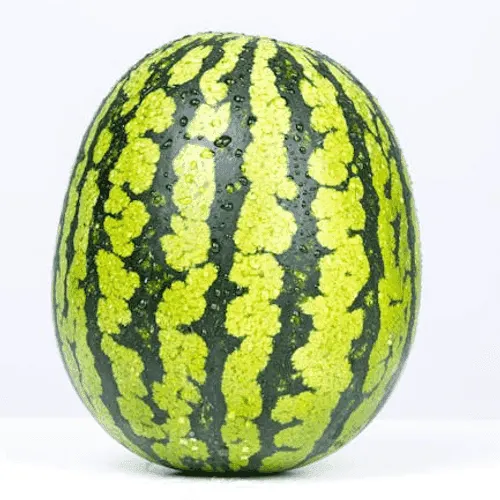
Watermelon: high in FODMAPs, oligosaccharides and fructose; moderate in histamine; low in salicylate and sucrose. If you're sensitive to any of these, check it against your profile before eating.
Intolerances
- FODMAPsHigh
Watermelon is the fruit whose level surprises people most, because it is almost all water. The concentration is modest; the problem is that nobody eats a small portion of watermelon. It also carries fructans as well as excess fructose, which is unusual for a fruit. The sugars behind this were measured on this fruit, in a study of four - peach, apple, watermelon and cherry - by HPLC. What it settles for this axis is presence and absence rather than a level: sorbitol was found in peach, apple and cherry and not in watermelon, and sucrose in peach, apple and watermelon and not in cherry. It publishes ranges across the four, never a value for one, so it cannot set a FODMAP level by itself.
Sources· 2
- Muir J et al., J Agric Food Chem 55 (2007) 6619-6627 and 57 (2009) 554-565, fructans and short-chain carbohydrates measured in Australian vegetables and fruit
- Ma C. et al., Food Chem 145 (2014) 784-788, fructose, sorbitol, glucose and sucrose in fruits by HPLC-ELSD
- OligosaccharidesFODMAPsHigh
Watermelon carries fructans as well as excess fructose, which is unusual for a fruit - most fruit brings sugar to this diet, not chains. The fructans are why the FODMAP level does not fall as far as the modest sugar content alone would suggest.
- FructoseFODMAPsHigh
Watermelon is mostly water, which misleads people - but what sugar it has runs fructose-heavy, and nobody eats a small portion of watermelon. The volume is the problem, not the concentration. The sugars here were separated and measured rather than looked up: across the four fruits in that study - peach, apple, watermelon and cherry - fructose ran 5.79 to 104.01 mg per gram, glucose 9.25 to 99.62 and sucrose 15.82 to 106.39. Those are RANGES across four fruits, not a value for this one, which is the honest limit of what an abstract gives. Muir names the watermelon among five fruits of 41 measured with more fructose than glucose; the study publishes no figure for it, only that it belongs to that group.
Sources· 2
- Ma C. et al., Food Chem 145 (2014) 784-788, fructose, sorbitol, glucose and sucrose in fruits by HPLC-ELSD
- Muir J. et al., J Agric Food Chem 57 (2009) 554-565, short-chain carbohydrates in 45 vegetables and 41 fruits
- Histamine (+liberators / DAO inhibitors)Moderate
Watermelon is a mild liberator eaten in the largest portions of any fruit here - nobody has a small piece of watermelon. It is also the melon most often bought halved and clingfilmed, which means it was cut in the shop rather than at home. Volume and cut time, both against it. The Swiss list, which marks L on everything it holds to be a liberator, rates “watermelon” 1 of 3 without that letter. A per-entry rating cannot see either the portion or how long ago the fruit was cut.
Sources· 3
- Maintz & Novak, Am J Clin Nutr 2007
- Zuberbier et al., EAACI/GA2LEN urticaria guideline
- SIGHI — Swiss Interest Group Histamine Intolerance, food-compatibility list (2024-08-29), for the entry, its rating and the absence of a liberator letter
- SalicylateLow
Mostly water, so the salicylate per gram is low. Servings are large, which is the only thing that makes it worth watching at all.
- SucroseLow
Watermelon carries sucrose - it is one of the three fruits in which it was measured, on a range of 15.82 to 106.39 mg per gram across the four studied. A range over four fruits is not a value for one of them; the measurement settles that it is there, not how much.
Sources· 1
- Ma C. et al., Food Chem 145 (2014) 784-788, fructose, sorbitol, glucose and sucrose in fruits by HPLC-ELSD
- TyramineNone
- LactoseFODMAPsNone
- SorbitolFODMAPsNone
The watermelon's answer here rests on a measurement rather than on an absence of data, which is rare on this axis: in the study behind it, sorbitol was found in peach, apple and cherry and NOT in watermelon. That is what separates it from the stone fruits it sits beside in a fruit bowl - they carry sorbitol and it does not.
Sources· 1
- Ma C. et al., Food Chem 145 (2014) 784-788, fructose, sorbitol, glucose and sucrose in fruits by HPLC-ELSD
- NickelNone
- OxalatesNone
- GlutenNone
Intolerance levels are based on our documented scientific sources. See sources →
React to FODMAPs? Check these too






More in Fruits
 Acorn squash
 Apple
Apple Apricot
 Apricot canned
 Aubergine
 Avocado
 Banana
 Bell pepper
 Blackberry
 Blackcurrant
 Blood orange
 Blueberry
Frequently asked questions
Which intolerances does watermelon affect?
Watermelon is notable for FODMAPs, oligosaccharides, fructose, histamine, salicylate and sucrose. Clear on tyramine, lactose, sorbitol, nickel, oxalates and gluten.
Does watermelon contain FODMAPs?
Yes — watermelon is high in FODMAPs. Watermelon is the fruit whose level surprises people most, because it is almost all water. The concentration is modest; the problem is that nobody eats a small portion of watermelon. It also carries fructans as well as excess fructose, which is unusual for a fruit. The sugars behind this were measured on this fruit, in a study of four - peach, apple, watermelon and cherry - by HPLC. What it settles for this axis is presence and absence rather than a level: sorbitol was found in peach, apple and cherry and not in watermelon, and sucrose in peach, apple and watermelon and not in cherry. It publishes ranges across the four, never a value for one, so it cannot set a FODMAP level by itself.
Does watermelon contain oligosaccharides?
Yes — watermelon is high in oligosaccharides. Watermelon carries fructans as well as excess fructose, which is unusual for a fruit - most fruit brings sugar to this diet, not chains. The fructans are why the FODMAP level does not fall as far as the modest sugar content alone would suggest.
Does watermelon contain fructose?
Yes — watermelon is high in fructose. Watermelon is mostly water, which misleads people - but what sugar it has runs fructose-heavy, and nobody eats a small portion of watermelon. The volume is the problem, not the concentration. The sugars here were separated and measured rather than looked up: across the four fruits in that study - peach, apple, watermelon and cherry - fructose ran 5.79 to 104.01 mg per gram, glucose 9.25 to 99.62 and sucrose 15.82 to 106.39. Those are RANGES across four fruits, not a value for this one, which is the honest limit of what an abstract gives. Muir names the watermelon among five fruits of 41 measured with more fructose than glucose; the study publishes no figure for it, only that it belongs to that group.
Does watermelon contain histamine?
Watermelon contains moderate levels of histamine. Watermelon is a mild liberator eaten in the largest portions of any fruit here - nobody has a small piece of watermelon. It is also the melon most often bought halved and clingfilmed, which means it was cut in the shop rather than at home. Volume and cut time, both against it. The Swiss list, which marks L on everything it holds to be a liberator, rates “watermelon” 1 of 3 without that letter. A per-entry rating cannot see either the portion or how long ago the fruit was cut. Amounts vary by brand and recipe, so always check the label of the exact product.
Check any product in seconds
Scan a barcode with the Yllo app and see straight away whether a product fits your intolerances.