Sun-dried tomato
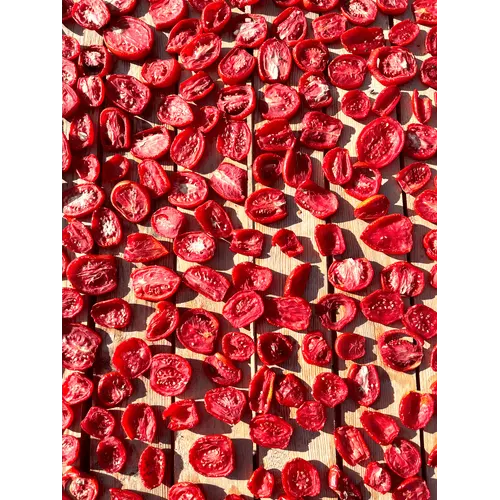
Other names Tomate séchée, Sun-dried tomatoes
Sun-dried tomato: high in FODMAPs, histamine and salicylate; moderate in fructose, tyramine and oxalates; low in oligosaccharides, sucrose and nickel. If you're sensitive to any of these, check it against your profile before eating.
Intolerances
- FODMAPsHigh
Sun-dried tomatoes are the most concentrated FODMAP form of a fruit that was already borderline, and they are eaten in slivers - which is what keeps the level from being higher. Two or three pieces is the practical limit.
Sources· 3
- Muir J et al., J Agric Food Chem 55 (2007) 6619-6627 and 57 (2009) 554-565, fructans and short-chain carbohydrates measured in Australian vegetables and fruit
- Tuck C et al., J Hum Nutr Diet 31 (2018), FODMAP content of common plant-based and processed foods
- USDA FoodData Central, the national nutrient database, queried for the sugar profile
- Histamine (+liberators / DAO inhibitors)High
Sun-dried tomatoes are tomatoes left in the sun for days - warm, moist and open to the air, which is the exact condition under which amines form. The drying is not a preservation step that came before the problem; it is days of the problem. The oil they are packed in then keeps them for months.
Sources· 2
- Maintz & Novak, Am J Clin Nutr 2007
- Comas-Baste et al., Biomolecules 2020
- SalicylateHigh
Drying concentrates what the fresh tomato held: the same salicylate in a fraction of the weight. A handful of sun-dried pieces carries far more than the tomato they came from.
Sources· 1
- Scotter M.J. et al., Food Chemistry 105 (2007), free and acetyl salicylic acid in foods by GC-MS, and Venema D. et al., J Agric Food Chem 44 (1996), acetylsalicylic and salicylic acid in foods by HPLC
- FructoseFODMAPsModerate
Sun-dried tomato concentrates the fruit's fructose several times over as the water leaves. Tomato is mild fresh; dried it is a different order, though the portion is small.
Sources· 1
- USDA FoodData Central, the national nutrient database, queried for the sugar profile
- TyramineModerate
Sun-dried tomatoes spend days warm, moist and open to the air - the exact condition under which amines form - and the drying then concentrates what was made. The oil they are packed in preserves them afterwards; it does nothing about what happened in the sun.
Sources· 2
- EFSA Journal 2011
- McCabe-Sellers et al., J Food Compos Anal 2006
- OxalatesModerate
Sun-dried tomato concentrates a fruit that is low in oxalate when fresh - drying multiplies everything, including the things that were small. It is eaten in slivers, which is what keeps the dose moderate rather than high.
Sources· 2
- Noonan SC & Savage GP, Asia Pac J Clin Nutr 8 (1999)
- USDA FoodData Central
- OligosaccharidesFODMAPsLow
Sun-dried tomato is high on the FODMAP axis for concentrated fructose, not for chains - tomato carries barely any. The two axes disagree because drying multiplies sugars and there was almost nothing to multiply here. Fruit oligosaccharides are the part of this axis least visible on a label: they are not sweetness and not fibre in the usual sense, and two fruits that taste alike can differ several-fold. The level follows measurements made on fruit specifically.
Sources· 1
- Muir J. et al., J Agric Food Chem 55 (2007) and 57 (2009), and Jovanovic-Malinovska R. et al., Int J Food Prop 17 (2014), oligosaccharides in fruit
- SucroseLow
Sun-dried tomato concentrates a fruit that was low in sucrose to begin with, and it is eaten in slivers rather than by the bowl.
Sources· 1
- USDA FoodData Central, the national nutrient database, queried for the sugar profile
- NickelLow
Sun-dried tomatoes concentrate the fruit several times over, and tomatoes take up rather more from soil than most fruits do. They stay low because they are eaten in slivers, not by the bowl. Drying is the whole question for nickel: water leaves and everything else stays, so a dried fruit carries the metal concentrated by weight. The level here follows a study of trace elements in DRIED fruit for that reason.
Sources· 1
- Duran A. et al., Int J Food Sci Nutr 59:7-8 (2008) 581-589, trace elements in dried fruit
- LactoseFODMAPsNone
- GlutenNo
- SorbitolFODMAPsNone
Intolerance levels are based on our documented scientific sources. See sources →
React to FODMAPs? Check these too






More in Fruits
 Acorn squash
 Apple
Apple Apricot
 Apricot canned
 Aubergine
 Avocado
 Banana
 Bell pepper
 Blackberry
 Blackcurrant
 Blood orange
 Blueberry
Frequently asked questions
Which intolerances does Sun-dried tomato affect?
Sun-dried tomato is notable for FODMAPs, histamine, salicylate, fructose, tyramine, oxalates, oligosaccharides, sucrose and nickel. Clear on lactose, gluten and sorbitol.
Does Sun-dried tomato contain FODMAPs?
Yes — Sun-dried tomato is high in FODMAPs. Sun-dried tomatoes are the most concentrated FODMAP form of a fruit that was already borderline, and they are eaten in slivers - which is what keeps the level from being higher. Two or three pieces is the practical limit.
Does Sun-dried tomato contain histamine?
Yes — Sun-dried tomato is high in histamine. Sun-dried tomatoes are tomatoes left in the sun for days - warm, moist and open to the air, which is the exact condition under which amines form. The drying is not a preservation step that came before the problem; it is days of the problem. The oil they are packed in then keeps them for months.
Does Sun-dried tomato contain salicylate?
Yes — Sun-dried tomato is high in salicylate. Drying concentrates what the fresh tomato held: the same salicylate in a fraction of the weight. A handful of sun-dried pieces carries far more than the tomato they came from.
Does Sun-dried tomato contain fructose?
Sun-dried tomato contains moderate levels of fructose. Sun-dried tomato concentrates the fruit's fructose several times over as the water leaves. Tomato is mild fresh; dried it is a different order, though the portion is small. Amounts vary by brand and recipe, so always check the label of the exact product.
Check any product in seconds
Scan a barcode with the Yllo app and see straight away whether a product fits your intolerances.