Nectarine
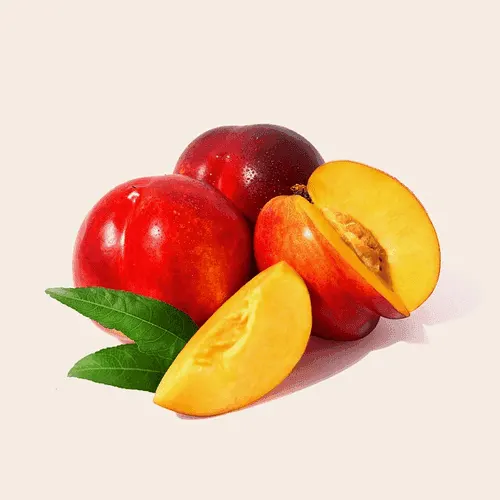
Nectarine: moderate in FODMAPs and sorbitol; low in salicylate, sucrose, oligosaccharides and nickel. If you're sensitive to any of these, check it against your profile before eating.
Intolerances
- FODMAPsModerate
Nectarine is a peach without the fuzz and behaves like one - sorbitol from the stone-fruit family, and a threshold around half a fruit. The missing skin texture makes no difference to the sugar.
Sources· 2
- Muir J et al., J Agric Food Chem 55 (2007) 6619-6627 and 57 (2009) 554-565, fructans and short-chain carbohydrates measured in Australian vegetables and fruit
- Lenhart A. & Chey W.D., Adv Nutr 8 (2017) 587-596, systematic review of the effects of polyols
- SorbitolFODMAPsModerate
Nectarine is a peach without the fuzz, and its sorbitol follows suit - present, a little lower, and still enough that portion size decides the outcome.
Sources· 1
- Lenhart A. & Chey W.D., Adv Nutr 8 (2017) 587-596, a systematic review of 79 studies on the effects of polyols
- SalicylateLow
Nectarine: the same fruit as a peach without the fuzz, and the same rule: the salicylate is in the skin, so peeling is what keeps it here.
- SucroseLow
Nectarine carries its sugar mostly as free glucose and fructose rather than as sucrose, so there is little for sucrase to split. Sweetness and sucrose content are not the same measurement, and this fruit is the proof.
- OligosaccharidesFODMAPsLow
Nectarine's FODMAP level is sorbitol from the stone-fruit family and excess fructose, neither of which is a chain. Stone fruit as a group is low here and moderate to high there, which is worth knowing when a whole category seems to be off the list. Fruit oligosaccharides are the part of this axis least visible on a label: they are not sweetness and not fibre in the usual sense, and two fruits that taste alike can differ several-fold. The level follows measurements made on fruit specifically.
Sources· 1
- Muir J. et al., J Agric Food Chem 55 (2007) and 57 (2009), and Jovanovic-Malinovska R. et al., Int J Food Prop 17 (2014), oligosaccharides in fruit
- NickelLow
Nectarines measure like peaches here, low, and the missing fuzz makes no difference to the nickel. Ripeness does not change it either. Nie measured peach among five Chinese deciduous fruits, and a nectarine is the same species; the five together came to no more than 1.1 per cent of the tolerable daily intake.
Sources· 1
- Nie J. et al., J Integr Agric 15:7 (2016) 1645-1655, heavy metals in the main deciduous fruits
- Histamine (+liberators / DAO inhibitors)None
A nectarine is eaten ripe, out of hand. A fruit offers little protein and no standing time, which is what this axis counts — drying, canning or fermenting would make a different food of it.
Sources· 1
- Maintz & Novak, Am J Clin Nutr 2007
- TyramineNone
- LactoseFODMAPsNone
- FructoseFODMAPsNone
- OxalatesNone
- GlutenNone
Intolerance levels are based on our documented scientific sources. See sources →
React to FODMAPs? Check these too






More in Fruits
 Acorn squash
 Apple
Apple Apricot
 Apricot canned
 Aubergine
 Avocado
 Banana
 Bell pepper
 Blackberry
 Blackcurrant
 Blood orange
 Blueberry
Frequently asked questions
Which intolerances does nectarine affect?
Nectarine is notable for FODMAPs, sorbitol, salicylate, sucrose, oligosaccharides and nickel. Clear on histamine, tyramine, lactose, fructose, oxalates and gluten.
Does nectarine contain FODMAPs?
Nectarine contains moderate levels of FODMAPs. Nectarine is a peach without the fuzz and behaves like one - sorbitol from the stone-fruit family, and a threshold around half a fruit. The missing skin texture makes no difference to the sugar.
Does nectarine contain sorbitol?
Nectarine contains moderate levels of sorbitol. Nectarine is a peach without the fuzz, and its sorbitol follows suit - present, a little lower, and still enough that portion size decides the outcome.
Does nectarine contain salicylate?
Nectarine contains only low levels of salicylate. Nectarine: the same fruit as a peach without the fuzz, and the same rule: the salicylate is in the skin, so peeling is what keeps it here.
Does nectarine contain sucrose?
Nectarine contains only low levels of sucrose. Nectarine carries its sugar mostly as free glucose and fructose rather than as sucrose, so there is little for sucrase to split. Sweetness and sucrose content are not the same measurement, and this fruit is the proof. Amounts vary by brand and recipe, so always check the label of the exact product.
Check any product in seconds
Scan a barcode with the Yllo app and see straight away whether a product fits your intolerances.