Kimchi
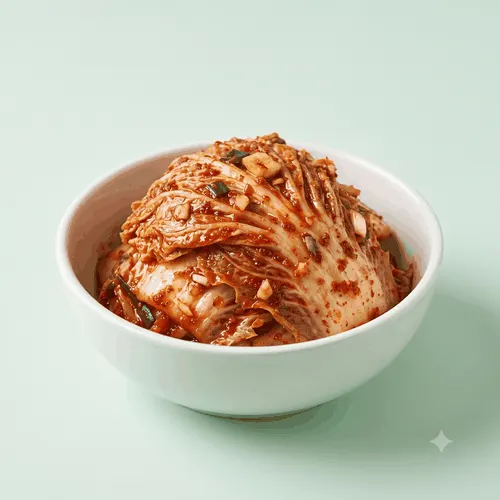
Other names kimchee, fermented napa cabbage
Kimchi: high in histamine, tyramine and salicylate; moderate in FODMAPs, oligosaccharides, sorbitol and nickel; low in gluten and oxalates. If you're sensitive to any of these, check it against your profile before eating.
Intolerances
- Histamine (+liberators / DAO inhibitors)High
Kimchi is fermented cabbage with garlic, ginger and chilli, and every part of that adds up here: the fermentation makes histamine, and the chilli is a liberator in its own right. Longer-aged kimchi carries more than freshly made. Retail surveys measure the spread: histamine from 3.3 to 386 mg per kilo depending on variety and age.
Sources· 1
- biogenic-amine surveys of retail kimchi, Foods 8(3):109 and 8(11):547 (2019)
- TyramineHigh
Kimchi is fermented vegetables with a long cure, and surveys of traditional fermented vegetables find tyramine among the amines that build. Unlike sauerkraut it also carries garlic and fish sauce in many recipes, both of which add their own. The same surveys put tyramine at up to 181 mg per kilo.
Sources· 1
- biogenic-amine surveys of retail kimchi, Foods 8(3):109 and 8(11):547 (2019)
- SalicylateHigh
Kimchi is high in salicylates because of what goes into it — chilli powder, garlic, ginger and spring onion — not because of the fermentation. The spice paste is the source.
- FODMAPsModerate
Kimchi is cabbage plus garlic and onion, and both of those are among the five vegetables measured highest in fructan. Fermentation cuts both ways here: the bacteria consume some of the cabbage fructan, and they produce mannitol, a polyol, as they go. One family falls and another rises, which is why the level lands in the middle rather than at either end. Monash gives a SERVE THRESHOLD, which is a different object from a content. A threshold answers how much, and for grams per hundred the papers are the source, not the app.
Sources· 2
- Monash University FODMAP composition tables and app, for the serve threshold
- Lenhart A. & Chey W.D., Adv Nutr 8 (2017) 587-596, systematic review of the effects of polyols
- OligosaccharidesFODMAPsModerate
Kimchi is fermented cabbage, and lactic fermentation consumes sugars - but kimchi is seasoned with garlic, and generously. The fermentation lowers the cabbage's oligosaccharides and does not remove the garlic's.
- SorbitolFODMAPsModerate
Kimchi picks up polyols from its fermentation, on top of the fructans of the garlic and onion it is built on. The polyol is the smaller of its two FODMAP problems.
Sources· 1
- Lenhart A. & Chey W.D., Adv Nutr 8 (2017) 587-596, a systematic review of 79 studies on the effects of polyols
- NickelModerate
Kimchi is cabbage, garlic, ginger and chilli - a stack of vegetables and ground spices, each contributing a little. Fermentation concentrates nothing here; the metal was in the plants before the jar was sealed. The nickel here follows a survey of heavy metals in VEGETABLES. A vegetable takes up what its soil holds, so a figure of this kind describes the growing region as much as the plant.
Sources· 1
- Guerra F. et al., Scientia Agricola 69:1 (2012) 54-60, heavy metals in vegetables
- GlutenPossible
Kimchi is cabbage, chilli, garlic and ginger, all gluten-free. Commercial jars often add wheat-based soy sauce or a wheat starch to thicken the paste, which is why the label matters more than the recipe. What a label may promise is set by regulation and not by a recipe: 828/2014 allows "gluten-free" at or below 20 mg/kg, sets the conditions oats must meet, and admits wheat-derived ingredients in a gluten-free food provided the finished product stays under that ceiling. It measures nothing — it says what a food must meet to carry the claim, which is exactly what a food name cannot tell you.
Sources· 1
- Commission Implementing Regulation (EU) No 828/2014, the conditions for a gluten-free claim
- OxalatesLow
Kimchi starts from cabbage, which is low, and fermentation does not create oxalate - bacteria make amines and acids, not plant minerals. What kimchi does add is the paste: chilli, garlic and ginger are spices, concentrated by weight and small by portion, and they are the only part of the jar that was not cabbage.
Sources· 1
- Noonan S.C. & Savage G.P., Asia Pac J Clin Nutr 8:1 (1999) 64-74, oxalate content of foods and its effect on humans
- LactoseFODMAPsNone
- FructoseFODMAPsNone
- SucroseNone
Intolerance levels are based on our documented scientific sources. See sources →
React to Histamine (+liberators / DAO inhibitors)? Check these too
More in Vegetables
 Artichoke
 Artichoke heart
 Bamboo shoots
 Beetroot
 Bitter gourd
 Black beans
 Broccoli
 Brussels sprouts
 Cabbage
 Carrot
 Cassava
 Cauliflower
Frequently asked questions
Which intolerances does kimchi affect?
Kimchi is notable for histamine, tyramine, salicylate, FODMAPs, oligosaccharides, sorbitol, nickel, gluten and oxalates. Clear on lactose, fructose and sucrose.
Does kimchi contain histamine?
Yes — kimchi is high in histamine. Kimchi is fermented cabbage with garlic, ginger and chilli, and every part of that adds up here: the fermentation makes histamine, and the chilli is a liberator in its own right. Longer-aged kimchi carries more than freshly made. Retail surveys measure the spread: histamine from 3.3 to 386 mg per kilo depending on variety and age.
Does kimchi contain tyramine?
Yes — kimchi is high in tyramine. Kimchi is fermented vegetables with a long cure, and surveys of traditional fermented vegetables find tyramine among the amines that build. Unlike sauerkraut it also carries garlic and fish sauce in many recipes, both of which add their own. The same surveys put tyramine at up to 181 mg per kilo.
Does kimchi contain salicylate?
Yes — kimchi is high in salicylate. Kimchi is high in salicylates because of what goes into it — chilli powder, garlic, ginger and spring onion — not because of the fermentation. The spice paste is the source.
Does kimchi contain FODMAPs?
Kimchi contains moderate levels of FODMAPs. Kimchi is cabbage plus garlic and onion, and both of those are among the five vegetables measured highest in fructan. Fermentation cuts both ways here: the bacteria consume some of the cabbage fructan, and they produce mannitol, a polyol, as they go. One family falls and another rises, which is why the level lands in the middle rather than at either end. Monash gives a SERVE THRESHOLD, which is a different object from a content. A threshold answers how much, and for grams per hundred the papers are the source, not the app. Amounts vary by brand and recipe, so always check the label of the exact product.
Check any product in seconds
Scan a barcode with the Yllo app and see straight away whether a product fits your intolerances.