Tamarind
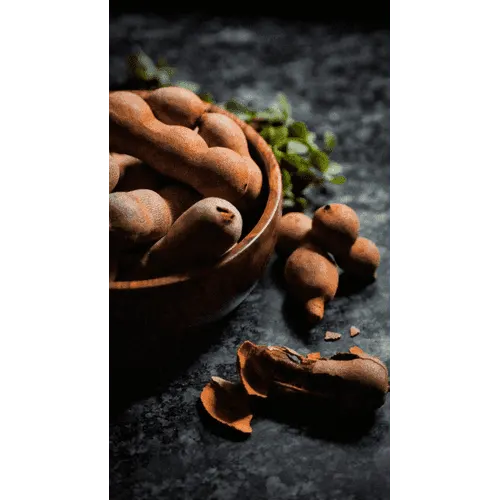
Other names Tamarin, Indian date
Tamarind: high in salicylate; moderate in FODMAPs, fructose, oligosaccharides and sucrose; low in histamine, nickel and oxalates. If you're sensitive to any of these, check it against your profile before eating.
Intolerances
- SalicylateHigh
Tamarind pulp is high in salicylates and is used precisely for the sourness that comes with them. It hides in sauces and chutneys, where it is rarely the ingredient people check.
Sources· 1
- Scotter M.J. et al., Food Chemistry 105 (2007), free and acetyl salicylic acid in foods by GC-MS, and Venema D. et al., J Agric Food Chem 44 (1996), acetylsalicylic and salicylic acid in foods by HPLC
- FODMAPsModerate
Tamarind is intensely sour, and the acidity hides how sugary the pulp is - which is the whole trap. It is used as a paste by the spoonful in cooking, so the dose is small, but a tamarind drink is a different matter. Prichard measured tamarind at 2.35 g of fructan per 100 g, the largest fructan figure in that survey.
Sources· 2
- Muir J et al., J Agric Food Chem 55 (2007) 6619-6627 and 57 (2009) 554-565, fructans and short-chain carbohydrates measured in Australian vegetables and fruit
- Prichard R et al., Int J Food Sci Nutr 67 (2016) 383-390, FODMAP content of foods commonly consumed by ethnic minority groups
- FructoseFODMAPsModerate
Tamarind pulp is fructose-bearing and intensely sour, which hides how sugary it is - the acidity masks the sweetness rather than replacing it.
- OligosaccharidesFODMAPsModerate
Tamarind carries more fructan than any other food in the twenty Prichard measured: 2.35 grams per hundred, above rye bread. What holds it down is the spoonful — it is a paste used to sour a dish, not a portion eaten on its own, and the figure is a content per hundred grams and not a threshold per serving.
Sources· 1
- Prichard R et al., Int J Food Sci Nutr 67 (2016) 383-390, FODMAP content of foods commonly consumed by ethnic minority groups
- SucroseModerate
Tamarind pulp is sucrose-bearing under its sourness. The acidity is what people notice, and it hides how much sugar is in a spoonful of paste.
- Histamine (+liberators / DAO inhibitors)Low
Tamarind pulp is low in histamine and strongly acidic, which keeps it that way. It is sold as a block or a concentrate and used in spoonfuls.
Sources· 1
- SIGHI — Swiss Interest Group Histamine Intolerance, food-compatibility list, for the entry, its rating and its letters
- NickelLow
Tamarind is a pod pulp, sour enough to be used as an acidulant - and acid is the thing that pulls metal out of a pan. The fruit is low; what it is cooked in matters more than what it is. Drying is the whole question for nickel: water leaves and everything else stays, so a dried fruit carries the metal concentrated by weight. The level here follows a study of trace elements in DRIED fruit for that reason.
Sources· 1
- Duran A. et al., Int J Food Sci Nutr 59:7-8 (2008) 581-589, trace elements in dried fruit
- OxalatesLow
Tamarind is low in oxalate, and the form matters more than the fruit: it is used as a paste or a concentrate, spoonfuls of sourness stirred into a whole pot, never eaten by the pod. Even a strong jar doses a dish, not a person.
Sources· 1
- Noonan S.C. & Savage G.P., Asia Pac J Clin Nutr 8:1 (1999) 64-74, oxalate content of foods and its effect on humans
- LactoseFODMAPsNone
- GlutenNo
- SorbitolFODMAPsNone
- TyramineNone
Intolerance levels are based on our documented scientific sources. See sources →
React to Salicylate? Check these too








More in Fruits
 Acorn squash
 Apple
Apple Apricot
 Apricot canned
 Aubergine
 Avocado
 Banana
 Bell pepper
 Blackberry
 Blackcurrant
 Blood orange
 Blueberry
Frequently asked questions
Which intolerances does Tamarind affect?
Tamarind is notable for salicylate, FODMAPs, fructose, oligosaccharides, sucrose, histamine, nickel and oxalates. Clear on lactose, gluten, sorbitol and tyramine.
Does Tamarind contain salicylate?
Yes — Tamarind is high in salicylate. Tamarind pulp is high in salicylates and is used precisely for the sourness that comes with them. It hides in sauces and chutneys, where it is rarely the ingredient people check.
Does Tamarind contain FODMAPs?
Tamarind contains moderate levels of FODMAPs. Tamarind is intensely sour, and the acidity hides how sugary the pulp is - which is the whole trap. It is used as a paste by the spoonful in cooking, so the dose is small, but a tamarind drink is a different matter. Prichard measured tamarind at 2.35 g of fructan per 100 g, the largest fructan figure in that survey.
Does Tamarind contain fructose?
Tamarind contains moderate levels of fructose. Tamarind pulp is fructose-bearing and intensely sour, which hides how sugary it is - the acidity masks the sweetness rather than replacing it.
Does Tamarind contain oligosaccharides?
Tamarind contains moderate levels of oligosaccharides. Tamarind carries more fructan than any other food in the twenty Prichard measured: 2.35 grams per hundred, above rye bread. What holds it down is the spoonful — it is a paste used to sour a dish, not a portion eaten on its own, and the figure is a content per hundred grams and not a threshold per serving. Amounts vary by brand and recipe, so always check the label of the exact product.
Check any product in seconds
Scan a barcode with the Yllo app and see straight away whether a product fits your intolerances.