Almond flour
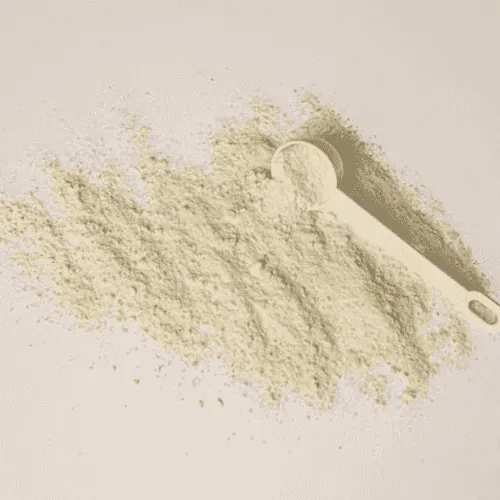
Almond flour: high in salicylate and oxalates; moderate in tyramine and nickel; low in histamine, FODMAPs and oligosaccharides. If you're sensitive to any of these, check it against your profile before eating.
Intolerances
- SalicylateHigh
Almond flour is ground almonds and inherits their high salicylate level, but the format changes the dose: a cake made with it uses far more almond than anyone would eat whole.
Sources· 1
- Duthie G.G. & Wood A.D., Food Funct 2 (2011) 515-520, natural salicylates in foods
- OxalatesHigh
Almond flour turns a nut into a staple, and the reason it matters here is arithmetic: a cup of it is the oxalate of around ninety almonds, where nobody would eat ninety almonds. It has become a staple precisely for people who bake around wheat, which is how a nut becomes a daily flour.
Sources· 2
- Noonan SC & Savage GP, Asia Pac J Clin Nutr 8 (1999)
- USDA FoodData Central
- TyramineModerate
Nuts appear on legacy MAOI lists and were dropped from the strict diet when the measurements came in - almond flour inherits that history rather than a number. It is here for completeness, and testing beats avoiding on principle.
Sources· 2
- Gardner et al., J Clin Psychiatry 1996, the review that narrowed the MAOI diet
- Shulman KI et al., J Clin Psychopharmacol 9 (1989)
- NickelModerate
Almond flour is nothing but ground almonds, so it carries the nut's nickel - and it is used by the cupful in gluten-free baking, where wheat flour would have been. The quantity is the thing to watch, not the ingredient.
Sources· 1
- Flyvholm M-A et al., Z Lebensm Unters Forsch 179 (1984) 427-431, nickel content of food and estimates of dietary intake
- Histamine (+liberators / DAO inhibitors)Low
Almond flour is ground almonds, and grinding exposes all of the oil to the air at once, so a bag goes rancid far faster than the almonds it was made from. That is worth knowing and it is not what this axis asks: rancidity is oxidation, yielding aldehydes and off-flavours, while amines need water and bacteria that a dry flour does not offer. Buy small bags, keep them in the freezer and smell before using - for the flavour. On this axis it sits exactly where the almond does, because grinding does not change which group a nut belongs to.
Sources· 2
- Maintz & Novak, Am J Clin Nutr 2007
- SIGHI food-compatibility list, for the elimination-list classification
- FODMAPsLow
Almond flour is ground almonds, low at a quarter cup. A flour concentrates whatever the seed held into a form used by the cupful, which is why the same plant can be low as a portion and high as a baked good. This food is not among the 55 grain products behind the per-portion FODMAP figures, so its level is a placing and not a measurement.
Sources· 2
- Biesiekierski J et al., J Hum Nutr Diet 24 (2011) 154-176, fructans and galacto-oligosaccharides per portion as eaten
- Whelan K et al., Int J Food Sci Nutr 62:5 (2011) 498-503, fructan measured in wheat, rye and gluten-free breads
- OligosaccharidesFODMAPsLow
Almond flour is ground almonds and carries their GOS, concentrated by the cup. A cake made with two cups of it divides that between slices - the number to watch is the slice, not the bag.
- SucroseNone
- LactoseFODMAPsNone
- SorbitolFODMAPsNone
- FructoseFODMAPsNone
- GlutenNo
Intolerance levels are based on our documented scientific sources. See sources →
React to Salicylate? Check these too





More in Flour
 Buckwheat flour
- Carob seed flour
- Cassava flour
- Chickpea flour
- Coconut flour
 Corn starch
- Flax flour
- Gluten-free flour
- Lupin flour
- Oat flour
 Potato starch
- Rice flour
Frequently asked questions
Which intolerances does almond flour affect?
Almond flour is notable for salicylate, oxalates, tyramine, nickel, histamine, FODMAPs and oligosaccharides. Clear on sucrose, lactose, sorbitol, fructose and gluten.
Does almond flour contain salicylate?
Yes — almond flour is high in salicylate. Almond flour is ground almonds and inherits their high salicylate level, but the format changes the dose: a cake made with it uses far more almond than anyone would eat whole.
Does almond flour contain oxalates?
Yes — almond flour is high in oxalates. Almond flour turns a nut into a staple, and the reason it matters here is arithmetic: a cup of it is the oxalate of around ninety almonds, where nobody would eat ninety almonds. It has become a staple precisely for people who bake around wheat, which is how a nut becomes a daily flour.
Does almond flour contain tyramine?
Almond flour contains moderate levels of tyramine. Nuts appear on legacy MAOI lists and were dropped from the strict diet when the measurements came in - almond flour inherits that history rather than a number. It is here for completeness, and testing beats avoiding on principle.
Does almond flour contain nickel?
Almond flour contains moderate levels of nickel. Almond flour is nothing but ground almonds, so it carries the nut's nickel - and it is used by the cupful in gluten-free baking, where wheat flour would have been. The quantity is the thing to watch, not the ingredient. Amounts vary by brand and recipe, so always check the label of the exact product.
Check any product in seconds
Scan a barcode with the Yllo app and see straight away whether a product fits your intolerances.