Guava
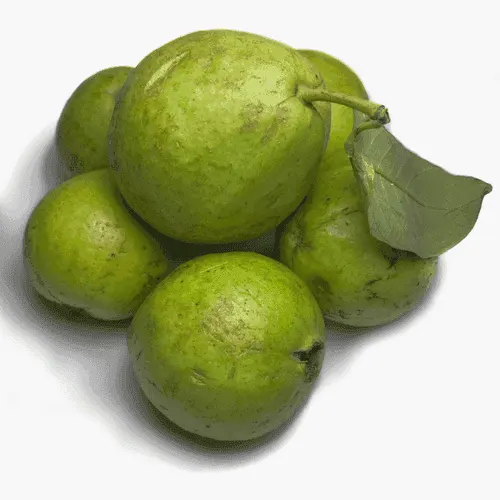
Other names guavas
Guava: high in salicylate, FODMAPs and fructose; low in oligosaccharides and oxalates. If you're sensitive to any of these, check it against your profile before eating.
Intolerances
- SalicylateHigh
Guava is high in salicylates whether eaten fresh or drunk as nectar, and the juice concentrates several fruits into one glass — a much larger dose than eating one.
Sources· 1
- Scotter M.J. et al., Food Chemistry 105 (2007), free and acetyl salicylic acid in foods by GC-MS, and Venema D. et al., J Agric Food Chem 44 (1996), acetylsalicylic and salicylic acid in foods by HPLC
- FODMAPsHigh
Guava is unusually sugary for its size and runs fructose-dominant. It is most often met as a juice or a paste rather than a whole fruit, and both concentrate it while removing the fibre that would have slowed it down. Prichard measured guava at 0.41 g of fructan per 100 g, with no galacto-oligosaccharides detected.
Sources· 2
- Muir J et al., J Agric Food Chem 55 (2007) 6619-6627 and 57 (2009) 554-565, fructans and short-chain carbohydrates measured in Australian vegetables and fruit
- Prichard R et al., Int J Food Sci Nutr 67 (2016) 383-390, FODMAP content of foods commonly consumed by ethnic minority groups
- FructoseFODMAPsHigh
Guava carries excess fructose and a lot of it - the fruit is unusually sugary for its size. Juiced or made into paste it concentrates further, and the fibre that would have slowed it is gone.
- OligosaccharidesFODMAPsLow
Prichard measured 0.41 grams of fructan per hundred in the guava, with no galacto-oligosaccharide detected — the smallest of the five foods that carried anything. The fruit's larger problem is on the fructose axis, where it already sits high.
Sources· 1
- Prichard R et al., Int J Food Sci Nutr 67 (2016) 383-390, FODMAP content of foods commonly consumed by ethnic minority groups
- OxalatesLow
Guava is low in oxalate, and it is eaten whole - peel, flesh and the hard little seeds, which are exactly where a plant stores this compound. Even so the serving is one fruit, and one fruit is a small dose.
Sources· 1
- Noonan S.C. & Savage G.P., Asia Pac J Clin Nutr 8:1 (1999) 64-74, oxalate content of foods and its effect on humans
- Histamine (+liberators / DAO inhibitors)None
Guava is eaten ripe, fresh and fragrant, within days. A fruit offers little protein and no standing time, which is what this axis counts — drying, canning or fermenting would make a different food of it.
Sources· 1
- Maintz & Novak, Am J Clin Nutr 2007
- TyramineNone
- SucroseNone
- LactoseFODMAPsNone
- SorbitolFODMAPsNone
- NickelNone
- GlutenNone
Intolerance levels are based on our documented scientific sources. See sources →
React to Salicylate? Check these too








More in Fruits
 Acorn squash
 Apple
Apple Apricot
 Apricot canned
 Aubergine
 Avocado
 Banana
 Bell pepper
 Blackberry
 Blackcurrant
 Blood orange
 Blueberry
Frequently asked questions
Which intolerances does guava affect?
Guava is notable for salicylate, FODMAPs, fructose, oligosaccharides and oxalates. Clear on histamine, tyramine, sucrose, lactose, sorbitol, nickel and gluten.
Does guava contain salicylate?
Yes — guava is high in salicylate. Guava is high in salicylates whether eaten fresh or drunk as nectar, and the juice concentrates several fruits into one glass — a much larger dose than eating one.
Does guava contain FODMAPs?
Yes — guava is high in FODMAPs. Guava is unusually sugary for its size and runs fructose-dominant. It is most often met as a juice or a paste rather than a whole fruit, and both concentrate it while removing the fibre that would have slowed it down. Prichard measured guava at 0.41 g of fructan per 100 g, with no galacto-oligosaccharides detected.
Does guava contain fructose?
Yes — guava is high in fructose. Guava carries excess fructose and a lot of it - the fruit is unusually sugary for its size. Juiced or made into paste it concentrates further, and the fibre that would have slowed it is gone.
Does guava contain oligosaccharides?
Guava contains only low levels of oligosaccharides. Prichard measured 0.41 grams of fructan per hundred in the guava, with no galacto-oligosaccharide detected — the smallest of the five foods that carried anything. The fruit's larger problem is on the fructose axis, where it already sits high. Amounts vary by brand and recipe, so always check the label of the exact product.
Check any product in seconds
Scan a barcode with the Yllo app and see straight away whether a product fits your intolerances.