Grape
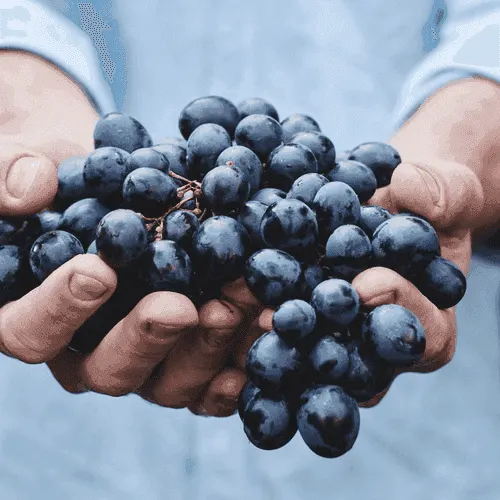
Grape: high in salicylate; low in FODMAPs. If you're sensitive to any of these, check it against your profile before eating.
Intolerances
- SalicylateHigh
Grape salicylate sits mostly in the skin, so dark grapes run higher than pale ones and raisins higher still. Peeling is impractical here — quantity is the workable lever.
Sources· 1
- Scotter M.J. et al., Food Chemistry 105 (2007), free and acetyl salicylic acid in foods by GC-MS, and Venema D. et al., J Agric Food Chem 44 (1996), acetylsalicylic and salicylic acid in foods by HPLC
- FODMAPsLow
Grape is low with a qualification worth knowing: balanced sugars, and one of the few fruits with no excess fructose. Fruit is where this axis is least intuitive, because sweetness and FODMAP load are not the same measurement - what counts is the balance between the sugars, not how much sugar there is.
Sources· 1
- Muir J et al., J Agric Food Chem 55 (2007) 6619-6627 and 57 (2009) 554-565, fructans and short-chain carbohydrates measured in Australian vegetables and fruit
- Histamine (+liberators / DAO inhibitors)None
The table grape is eaten fresh - wine, raisins and juice are what time and process make of it.
Sources· 1
- Maintz & Novak, Am J Clin Nutr 2007
- TyramineNone
- SucroseNone
- LactoseFODMAPsNone
- OligosaccharidesFODMAPsNone
- SorbitolFODMAPsNone
- FructoseFODMAPsNone
Grapes carry about 8 g of fructose per 100 g, which is not a small amount - but they carry 7 g of glucose alongside it, and that is what decides this axis. Fructose is absorbed by co-transport with glucose, so what fails to be absorbed is the fructose IN EXCESS, and the excess here is under a gram. It is the same reason raisins and sultanas read none: drying multiplies both sugars equally and cannot create an imbalance that was not there. Anyone avoiding fructose by total intake rather than by ratio should read the 8 g, not the level.
Sources· 2
- (HPLC-ELSD)
- USDA FoodData Central
- NickelNone
Grape came out the lowest of the five fruits Nie measured for nickel, which is the one place in that study where a fruit is named at an end of the ranking rather than left in the middle. Lead, cadmium, chromium and nickel were measured across China's main growing areas; nickel led the four, and the five fruits together supply no more than 1.1 per cent of the tolerable daily intake.
Sources· 1
- Nie J. et al., J Integr Agric 15:7 (2016) 1645-1655, heavy metals in the main deciduous fruits
- OxalatesNone
- GlutenNone
Intolerance levels are based on our documented scientific sources. See sources →
React to Salicylate? Check these too




More in Fruits
 Acorn squash
 Apple
Apple Apricot
 Apricot canned
 Aubergine
 Avocado
 Banana
 Bell pepper
 Blackberry
 Blackcurrant
 Blood orange
 Blueberry
Frequently asked questions
Which intolerances does grape affect?
Grape is notable for salicylate and FODMAPs. Clear on histamine, tyramine, sucrose, lactose, oligosaccharides, sorbitol, fructose, nickel, oxalates and gluten.
Does grape contain salicylate?
Yes — grape is high in salicylate. Grape salicylate sits mostly in the skin, so dark grapes run higher than pale ones and raisins higher still. Peeling is impractical here — quantity is the workable lever.
Does grape contain FODMAPs?
Grape contains only low levels of FODMAPs. Grape is low with a qualification worth knowing: balanced sugars, and one of the few fruits with no excess fructose. Fruit is where this axis is least intuitive, because sweetness and FODMAP load are not the same measurement - what counts is the balance between the sugars, not how much sugar there is. Amounts vary by brand and recipe, so always check the label of the exact product.
Check any product in seconds
Scan a barcode with the Yllo app and see straight away whether a product fits your intolerances.