Date
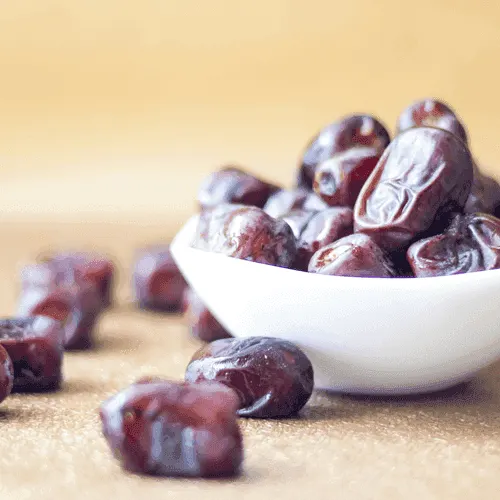
Date: high in salicylate, FODMAPs and oligosaccharides; low in histamine, sucrose, sorbitol and oxalates. If you're sensitive to any of these, check it against your profile before eating.
Intolerances
- SalicylateHigh
Dates are dried fruit, so the salicylate that was in the fresh date is packed into a much smaller weight. They are eaten as a sweet snack, which makes the portion easy to overshoot.
Sources· 1
- Scotter M.J. et al., Food Chemistry 105 (2007), free and acetyl salicylic acid in foods by GC-MS, and Venema D. et al., J Agric Food Chem 44 (1996), acetylsalicylic and salicylic acid in foods by HPLC
- FODMAPsHigh
Dates fail on fructans rather than on fructose, which makes them different from every other dried fruit here. Two dates is around the limit, and the stickiness that makes them a baking staple is exactly what makes the portion creep.
Sources· 2
- Muir J et al., J Agric Food Chem 55 (2007) 6619-6627 and 57 (2009) 554-565, fructans and short-chain carbohydrates measured in Australian vegetables and fruit
- USDA FoodData Central, the national nutrient database, queried for the sugar profile
- OligosaccharidesFODMAPsHigh
The fructans are what put the date on the FODMAP axis, and fructans are oligosaccharides - so the two levels have to agree. Two dates is around the usual limit, and the stickiness that makes them a baking staple is exactly what makes the portion creep.
Sources· 1
- Muir J et al., J Agric Food Chem 55 (2007) and 57 (2009)
- Histamine (+liberators / DAO inhibitors)Low
A date starts from a low-histamine fresh fruit, and drying concentrates rather than creates: the water leaves and everything else stays. Sun-dried fruit has had more warm hours than kiln-dried, which is the variable no label records.
Sources· 1
- SIGHI — Swiss Interest Group Histamine Intolerance, food-compatibility list, for the entry, its rating and its letters
- SucroseLow
Date carries its sugar mostly as free glucose and fructose rather than as sucrose, so there is little for sucrase to split. Sweetness and sucrose content are not the same measurement, and this fruit is the proof.
- SorbitolFODMAPsLow
Dates are dried, but drying only concentrates what was there, and the fresh fruit carries little sorbitol. Their FODMAP problem is fructans, not polyols.
Sources· 1
- Lenhart A. & Chey W.D., Adv Nutr 8 (2017) 587-596, a systematic review of 79 studies on the effects of polyols
- OxalatesLow
Dates are low in oxalate, and a date is dried fruit by nature: the water left on the palm, so each one is already the concentrated form of itself. Two or three make a serving, and that small unit is what keeps the total low.
Sources· 1
- Noonan S.C. & Savage G.P., Asia Pac J Clin Nutr 8:1 (1999) 64-74, oxalate content of foods and its effect on humans
- TyramineNone
- LactoseFODMAPsNone
- FructoseFODMAPsNone
A date is a third sugar by weight and a large part of that is fructose - a Medjool carries about 32 g per 100 g. What this axis measures is fructose IN EXCESS of glucose, because glucose carries fructose across the gut wall, and dates have slightly more glucose than fructose (33.7 against 32.0 in Medjool, 19.9 against 19.6 in Deglet Noor). So there is no excess to malabsorb, and plenty of fructose. If you avoid fructose by total load rather than by ratio - hereditary fructose intolerance - this is one of the densest sources there is. What makes a date hard work for everyone else is its fructans.
Sources· 2
- (HPLC-ELSD)
- USDA FoodData Central
- GlutenNone
- NickelNone
Intolerance levels are based on our documented scientific sources. See sources →
React to Salicylate? Check these too








More in Fruits
 Acorn squash
 Apple
Apple Apricot
 Apricot canned
 Aubergine
 Avocado
 Banana
 Bell pepper
 Blackberry
 Blackcurrant
 Blood orange
 Blueberry
Frequently asked questions
Which intolerances does date affect?
Date is notable for salicylate, FODMAPs, oligosaccharides, histamine, sucrose, sorbitol and oxalates. Clear on tyramine, lactose, fructose, gluten and nickel.
Does date contain salicylate?
Yes — date is high in salicylate. Dates are dried fruit, so the salicylate that was in the fresh date is packed into a much smaller weight. They are eaten as a sweet snack, which makes the portion easy to overshoot.
Does date contain FODMAPs?
Yes — date is high in FODMAPs. Dates fail on fructans rather than on fructose, which makes them different from every other dried fruit here. Two dates is around the limit, and the stickiness that makes them a baking staple is exactly what makes the portion creep.
Does date contain oligosaccharides?
Yes — date is high in oligosaccharides. The fructans are what put the date on the FODMAP axis, and fructans are oligosaccharides - so the two levels have to agree. Two dates is around the usual limit, and the stickiness that makes them a baking staple is exactly what makes the portion creep.
Does date contain histamine?
Date contains only low levels of histamine. A date starts from a low-histamine fresh fruit, and drying concentrates rather than creates: the water leaves and everything else stays. Sun-dried fruit has had more warm hours than kiln-dried, which is the variable no label records. Amounts vary by brand and recipe, so always check the label of the exact product.
Check any product in seconds
Scan a barcode with the Yllo app and see straight away whether a product fits your intolerances.