Coconut
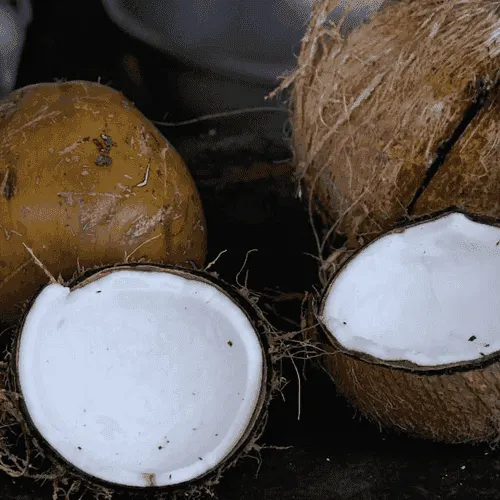
Coconut: high in nickel; low in histamine. If you're sensitive to any of these, check it against your profile before eating.
Intolerances
- NickelHigh
Coconut is high in nickel, which surprises people who file it with the tropical fruit rather than with the nuts and seeds. The palm draws the metal up through sandy coastal soil. Coconut is one of the few plant foods measured for this axis in its own right: the level follows a survey of essential and non-essential metals across COCONUT PRODUCTS, which is why the water, the flesh and the milk do not all read the same here.
Sources· 1
- Ahmed M. et al., J Food Compos Anal 127 (2024) 105943, essential and non-essential metals in coconut products
- Histamine (+liberators / DAO inhibitors)Low
Fresh coconut is low in histamine, and it does not stay that way once opened: the flesh is roughly a third fat and still moist, which is a substrate that spoils rather than keeps, and cracking the shell removes the only barrier it had. Desiccated coconut is the other question - it is shelf-stable for months, and months is what builds amines. The coconut is one of the twelve Yilmaz measured for serotonin, and the part that applies to it is the processing: roasting took the maximum of the whole set from 155 micrograms per gram down to 15.3. What is done to a nut moves this kind of amine more than which nut it is.
Sources· 3
- Maintz & Novak, Am J Clin Nutr 2007
- McCabe-Sellers et al., J Food Compos Anal 2006
- Yilmaz C et al., Food Chem 272 (2019) 347-353, serotonin in twelve nuts, raw and roasted
- TyramineNone
- SalicylateNone
- SucroseNone
- FODMAPsNone
- LactoseFODMAPsNone
- OligosaccharidesFODMAPsNone
- SorbitolFODMAPsNone
- FructoseFODMAPsNone
- OxalatesNone
- GlutenNo
Intolerance levels are based on our documented scientific sources. See sources →
React to Nickel? Check these too








More in Fruits
 Acorn squash
 Apple
Apple Apricot
 Apricot canned
 Aubergine
 Avocado
 Banana
 Bell pepper
 Blackberry
 Blackcurrant
 Blood orange
 Blueberry
Frequently asked questions
Which intolerances does coconut affect?
Coconut is notable for nickel and histamine. Clear on tyramine, salicylate, sucrose, FODMAPs, lactose, oligosaccharides, sorbitol, fructose, oxalates and gluten.
Does coconut contain nickel?
Yes — coconut is high in nickel. Coconut is high in nickel, which surprises people who file it with the tropical fruit rather than with the nuts and seeds. The palm draws the metal up through sandy coastal soil. Coconut is one of the few plant foods measured for this axis in its own right: the level follows a survey of essential and non-essential metals across COCONUT PRODUCTS, which is why the water, the flesh and the milk do not all read the same here.
Does coconut contain histamine?
Coconut contains only low levels of histamine. Fresh coconut is low in histamine, and it does not stay that way once opened: the flesh is roughly a third fat and still moist, which is a substrate that spoils rather than keeps, and cracking the shell removes the only barrier it had. Desiccated coconut is the other question - it is shelf-stable for months, and months is what builds amines. The coconut is one of the twelve Yilmaz measured for serotonin, and the part that applies to it is the processing: roasting took the maximum of the whole set from 155 micrograms per gram down to 15.3. What is done to a nut moves this kind of amine more than which nut it is. Amounts vary by brand and recipe, so always check the label of the exact product.
Check any product in seconds
Scan a barcode with the Yllo app and see straight away whether a product fits your intolerances.