Sweet rosé wine
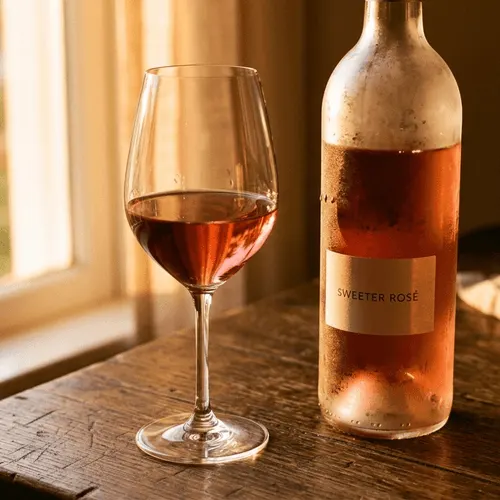
Other names sweet pink wine
Sweet rosé wine: high in FODMAPs and fructose; moderate in histamine and salicylate; low in tyramine. If you're sensitive to any of these, check it against your profile before eating.
Intolerances
- FODMAPsHigh
Sweet rosé is fermented only partway on purpose, which leaves sugar in the bottle - and because the yeast ate the glucose first, what remains leans towards fructose. The sweetness you taste and the FODMAP load track each other closely here.
Sources· 2
- Tuck C et al., J Hum Nutr Diet 31 (2018), FODMAP content of common plant-based and processed foods
- USDA FoodData Central, the national nutrient database, queried for the sugar profile
- FructoseFODMAPsHigh
Sweet rosé is fermented only partway, deliberately leaving sugar in the bottle. Because yeast eats glucose first, the sugar it leaves behind is the fructose - which is why sweet wines land harder than their sugar figure suggests.
Sources· 1
- USDA FoodData Central, the national nutrient database, queried for the sugar profile
- Histamine (+liberators / DAO inhibitors)Moderate
Sweet rosé is stopped part-way through fermentation, usually by chilling and sulfiting - and that second word is the point: a wine whose fermentation was halted chemically carries more sulfite than one allowed to finish. Sulfite is a sensitivity of its own rather than a mechanism on this axis, so what it adds here is a second question rather than more of the first. The first is the alcohol, which the reviews do describe as a DAO inhibitor, and the histamine the fermentation made before it was stopped.
Sources· 4
- Maintz & Novak, Am J Clin Nutr 2007
- Comas-Baste et al., Biomolecules 2020
- EFSA (2016), re-evaluation of sulfur dioxide and the sulfites, EFSA Journal 14(4):4438
- Reg. (EU) No 1169/2011 Annex II for the 10 mg/kg declaration
- SalicylateModerate
Rosé has limited skin contact, so it carries less grape salicylate than red — but the alcohol still worsens tolerance, and residual sugar changes nothing on this axis. Neither study publishes a value for this particular drink.
Sources· 2
- Duthie G.G. & Wood A.D., Food Funct 2 (2011) 515-520, natural salicylates in foods
- Scotter M.J. et al., Food Chem 105 (2007) 273-279, and Venema D. et al., J Agric Food Chem 44 (1996) 1762-1767
- TyramineLow
Sweet rosé wine is low, and that is a correction to older advice. The assay that measured tyramine in more than a hundred foods to guide MAOI patients found alcoholic drinks in moderation to be safe - including the Chianti that older lists singled out. The alcohol itself remains a separate issue.
- SucroseNone
- LactoseFODMAPsNone
- OligosaccharidesFODMAPsNone
- SorbitolFODMAPsNone
- NickelNone
- OxalatesNone
- GlutenNo
Intolerance levels are based on our documented scientific sources. See sources →
React to FODMAPs? Check these too









More in Drinks
 Advocaat
 Alcohol
 Alcohol free beer
 Almond Milk
 Apple juice concentrate
- Beer
 Black tea
- Cashew milk
 Champagne
- Coconut Milk
 Coconut water
 Coffee
Frequently asked questions
Which intolerances does sweet rosé wine affect?
Sweet rosé wine is notable for FODMAPs, fructose, histamine, salicylate and tyramine. Clear on sucrose, lactose, oligosaccharides, sorbitol, nickel, oxalates and gluten.
Does sweet rosé wine contain FODMAPs?
Yes — sweet rosé wine is high in FODMAPs. Sweet rosé is fermented only partway on purpose, which leaves sugar in the bottle - and because the yeast ate the glucose first, what remains leans towards fructose. The sweetness you taste and the FODMAP load track each other closely here.
Does sweet rosé wine contain fructose?
Yes — sweet rosé wine is high in fructose. Sweet rosé is fermented only partway, deliberately leaving sugar in the bottle. Because yeast eats glucose first, the sugar it leaves behind is the fructose - which is why sweet wines land harder than their sugar figure suggests.
Does sweet rosé wine contain histamine?
Sweet rosé wine contains moderate levels of histamine. Sweet rosé is stopped part-way through fermentation, usually by chilling and sulfiting - and that second word is the point: a wine whose fermentation was halted chemically carries more sulfite than one allowed to finish. Sulfite is a sensitivity of its own rather than a mechanism on this axis, so what it adds here is a second question rather than more of the first. The first is the alcohol, which the reviews do describe as a DAO inhibitor, and the histamine the fermentation made before it was stopped.
Does sweet rosé wine contain salicylate?
Sweet rosé wine contains moderate levels of salicylate. Rosé has limited skin contact, so it carries less grape salicylate than red — but the alcohol still worsens tolerance, and residual sugar changes nothing on this axis. Neither study publishes a value for this particular drink. Amounts vary by brand and recipe, so always check the label of the exact product.
Check any product in seconds
Scan a barcode with the Yllo app and see straight away whether a product fits your intolerances.