Pesto
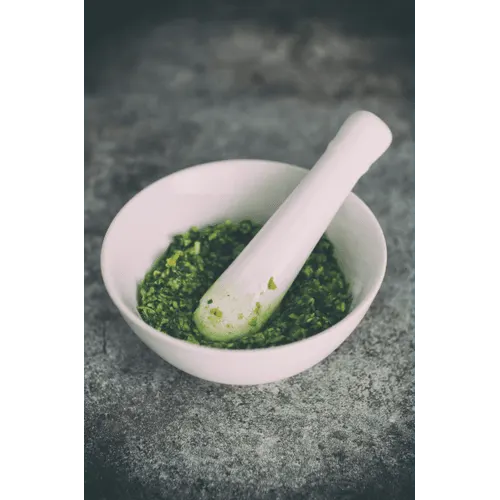
Other names Pesto sauce, Sauce pesto
Pesto: moderate in FODMAPs, histamine, oligosaccharides, tyramine and salicylate; low in lactose, gluten, nickel and oxalates. If you're sensitive to any of these, check it against your profile before eating.
Intolerances
- FODMAPsModerate
Pesto is high in FODMAP mainly from garlic (fructans), plus some lactose from cheese. A garlic-free pesto, or just a small amount, keeps it lower in FODMAP.
- Histamine (+liberators / DAO inhibitors)Moderate
Pesto is not fermented, but it is blended - which exposes everything at once to air - and then kept open in the fridge. It also stacks aged cheese, pine nuts and garlic, three histamine entries of their own. The date you opened the jar matters more than the date on the lid.
Sources· 2
- Maintz & Novak, Am J Clin Nutr 2007
- Zuberbier et al., EAACI/GA2LEN urticaria guideline
- OligosaccharidesFODMAPsModerate
Pesto is basil, oil, cheese, pine nuts and garlic, and only the last of those brings an oligosaccharide. A garlic-free pesto is low here, which makes this one of the easiest sauces to make compliant. This is a PREPARED food, and that is the difficulty on this axis: the oligosaccharides come from whatever went in - onion, garlic, a legume, an added fibre - not from a single plant that could be looked up. The level follows work on fructooligosaccharides in prepared and preserved foods for that reason. The survey behind this ranks by PLANT FAMILY rather than by food: the Compositae highest in total fructooligosaccharide, then the Allium species. A prepared food takes its place from whichever of those went into it - onion and garlic are Allium, artichoke and chicory are Compositae - and the survey names no prepared food itself.
Sources· 2
- Hogarth A. et al., J Agric Food Chem 48 (2000), fructooligosaccharides in prepared and preserved foods
- Campbell J.M. et al., J Agric Food Chem 45 (1997) 3076-3082, fructooligosaccharide composition of foods and feeds
- TyramineModerate
Pesto is blended and then kept open in the fridge, and both halves matter: blending exposes everything to air at once, and an opened jar keeps working for weeks. It also contains aged cheese, which is the larger tyramine contributor of the two.
Sources· 2
- EFSA Journal 2011
- McCabe-Sellers et al., J Food Compos Anal 2006
- SalicylateModerate
Pesto stacks basil, garlic, pine nuts and often lemon — four moderate salicylate sources blended into one condiment, which is why it lands above any of its parts.
Sources· 1
- Duthie G.G. & Wood A.D., Food Funct 2 (2011) 515-520, natural salicylates in foods
- LactoseFODMAPsLow
Pesto does not hide dairy either - pecorino or parmesan is in the recipe by definition, and both are aged cheeses with almost no lactose left. The dairy-free versions exist and taste different; the standard one is low here for the same reason a hard cheese is.
Sources· 3
- Regulation (EU) No 1169/2011, Annex II, which requires milk to be declared as an allergen
- USDA FoodData Central
- Schweizer Nährwertdatenbank v6.3 (2021), Bundesamt für Lebensmittelsicherheit, consulted as a third lactose reading
- GlutenPossible
Pesto is basil, oil, cheese, nuts and garlic - nothing with gluten in the recipe. What puts it here is that supermarket versions bulk out the expensive parts with breadcrumb or potato flake, and the cheaper the jar the likelier that is.
Sources· 2
- Regulation (EU) No 1169/2011, Annex II
- Commission Implementing Regulation (EU) No 828/2014 (gluten-free at or below 20 mg/kg)
- NickelLow
Pesto is basil, pine nuts, cheese and oil. Each part is low, and the nuts - the only ingredient that could raise it - are a small fraction of the jar.
Sources· 1
- Cabrera-Vique C. et al., Sci Total Environ 409 (2011) 1584-1588, nickel in convenience and fast foods and its dialysable fraction
- OxalatesLow
Pesto is basil, pine nuts, cheese and oil. Basil is a herb and herbs measure high by weight, but a jar is mostly oil - and the parmesan in it brings calcium that binds part of the oxalate the basil contributed.
Sources· 1
- Noonan S.C. & Savage G.P., Asia Pac J Clin Nutr 8:1 (1999) 64-74, oxalate content of foods and its effect on humans
- FructoseFODMAPsNone
- SorbitolFODMAPsNone
- SucroseNone
Intolerance levels are based on our documented scientific sources. See sources →
React to FODMAPs? Check these too









More in Other
 Almond butter
 Almond cream
 Almond yogurt
 Apple puree
 Beef broth
 Beef gelatin
 Beetroot juice powder
 Bouillon cube
 Breadcrumbs
 Calcium
 Cashew cheese
 Chicken broth
Frequently asked questions
Which intolerances does Pesto affect?
Pesto is notable for FODMAPs, histamine, oligosaccharides, tyramine, salicylate, lactose, gluten, nickel and oxalates. Clear on fructose, sorbitol and sucrose.
Does Pesto contain FODMAPs?
Pesto contains moderate levels of FODMAPs. Pesto is high in FODMAP mainly from garlic (fructans), plus some lactose from cheese. A garlic-free pesto, or just a small amount, keeps it lower in FODMAP.
Does Pesto contain histamine?
Pesto contains moderate levels of histamine. Pesto is not fermented, but it is blended - which exposes everything at once to air - and then kept open in the fridge. It also stacks aged cheese, pine nuts and garlic, three histamine entries of their own. The date you opened the jar matters more than the date on the lid.
Does Pesto contain oligosaccharides?
Pesto contains moderate levels of oligosaccharides. Pesto is basil, oil, cheese, pine nuts and garlic, and only the last of those brings an oligosaccharide. A garlic-free pesto is low here, which makes this one of the easiest sauces to make compliant. This is a PREPARED food, and that is the difficulty on this axis: the oligosaccharides come from whatever went in - onion, garlic, a legume, an added fibre - not from a single plant that could be looked up. The level follows work on fructooligosaccharides in prepared and preserved foods for that reason. The survey behind this ranks by PLANT FAMILY rather than by food: the Compositae highest in total fructooligosaccharide, then the Allium species. A prepared food takes its place from whichever of those went into it - onion and garlic are Allium, artichoke and chicory are Compositae - and the survey names no prepared food itself.
Does Pesto contain tyramine?
Pesto contains moderate levels of tyramine. Pesto is blended and then kept open in the fridge, and both halves matter: blending exposes everything to air at once, and an opened jar keeps working for weeks. It also contains aged cheese, which is the larger tyramine contributor of the two. Amounts vary by brand and recipe, so always check the label of the exact product.
Check any product in seconds
Scan a barcode with the Yllo app and see straight away whether a product fits your intolerances.