Granola
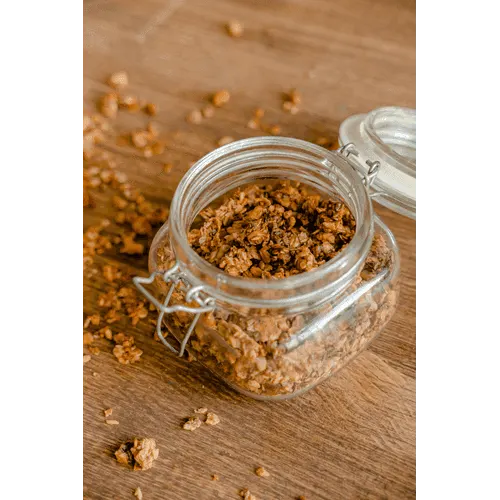
Other names Müesli grillé, Knuspermüsli
Granola: moderate in FODMAPs, fructose, oligosaccharides, sucrose, salicylate, nickel and oxalates; low in histamine, gluten and sorbitol. If you're sensitive to any of these, check it against your profile before eating.
Intolerances
- FODMAPsModerate
In granola the oats are usually the least of it. What decides a given brand is what was added: dried fruit, honey, apple juice concentrate, cashews - each of which is high here on its own. Read the fruit and nut line before the grain line. This food is not among the 55 grain products behind the per-portion FODMAP figures, so its level is a placing and not a measurement.
Sources· 3
- Tuck C et al., J Hum Nutr Diet 31 (2018), FODMAP content of common plant-based and processed foods
- Biesiekierski J et al., J Hum Nutr Diet 24 (2011) 154-176, fructans and galacto-oligosaccharides per portion as eaten
- USDA FoodData Central, the national nutrient database, queried for the sugar profile
- FructoseFODMAPsModerate
Granola often adds fructose through dried fruit, honey or fruit-juice concentrate. A version sweetened with glucose or maple syrup is easier to tolerate in fructose malabsorption.
- OligosaccharidesFODMAPsModerate
The oats are the least of it. What brings chains to a granola is what was added: dried fruit fructans, cashew GOS, inulin declared as fibre - three different oligosaccharides in one bowl, from three different ingredients. This is a PREPARED food, and that is the difficulty on this axis: the oligosaccharides come from whatever went in - onion, garlic, a legume, an added fibre - not from a single plant that could be looked up. The level follows work on fructooligosaccharides in prepared and preserved foods for that reason. The survey behind this ranks by PLANT FAMILY rather than by food: the Compositae highest in total fructooligosaccharide, then the Allium species. A prepared food takes its place from whichever of those went into it - onion and garlic are Allium, artichoke and chicory are Compositae - and the survey names no prepared food itself.
Sources· 2
- Hogarth A. et al., J Agric Food Chem 48 (2000), fructooligosaccharides in prepared and preserved foods
- Campbell J.M. et al., J Agric Food Chem 45 (1997) 3076-3082, fructooligosaccharide composition of foods and feeds
- SucroseModerate
Granola is bound with syrup - that is what makes it clump - so the sugar is structural rather than optional. Dried fruit stirred through adds more.
Sources· 1
- USDA FoodData Central, the national nutrient database, queried for the sugar profile
- SalicylateModerate
Oats are low in salicylate, but granola is rarely just oats — dried fruit, nuts, honey and cinnamon are all moderate to high, and a bowl combines several of them.
Sources· 1
- Duthie G.G. & Wood A.D., Food Funct 2 (2011) 515-520, natural salicylates in foods
- NickelModerate
Granola is oats and nuts, the two things at the top of the nickel table, bound with syrup. Nothing in it is extreme on its own; the combination and the bowl size are what put it here.
Sources· 1
- Flyvholm M-A et al., Z Lebensm Unters Forsch 179 (1984) 427-431, nickel content of food and estimates of dietary intake
- OxalatesModerate
Granola's oxalates come mainly from its nuts, seeds, cocoa or wheat bran, so check the mix. A nut-light granola is lower in oxalate.
- Histamine (+liberators / DAO inhibitors)Low
Granola is low because it is oats and nuts baked dry, with no wet stage for bacteria. Baking and drying are the two processes that end the amine question rather than starting it - heat kills the bacteria and dryness stops the rest. A sourdough proved for two days is the counter-example.
Sources· 1
- SIGHI — Swiss Interest Group Histamine Intolerance, food-compatibility list, for the entry, its rating and its letters
- GlutenPossible
Granola is oats, and oats are counted as a gluten cereal by the law even though the protein they carry is avenin rather than wheat gluten - both regulations name oats explicitly. On top of that they are almost always grown, harvested and milled alongside wheat, which is why gluten-free oats are a separate and more expensive product. What a label may promise is set by regulation and not by a recipe: 828/2014 allows "gluten-free" at or below 20 mg/kg, sets the conditions oats must meet, and admits wheat-derived ingredients in a gluten-free food provided the finished product stays under that ceiling. It measures nothing — it says what a food must meet to carry the claim, which is exactly what a food name cannot tell you.
Sources· 3
- Commission Implementing Regulation (EU) No 828/2014, the conditions for a gluten-free claim
- Regulation (EU) No 1169/2011, Annex II, the substances requiring declaration and their named exemptions
- Commission Implementing Regulation (EU) No 828/2014, Article 2 and the Annex — the definition of gluten and the two thresholds
- SorbitolFODMAPsLow
Granola picks up sorbitol from what binds it - apple juice concentrate and dried fruit both carry it, and both are common here. The oats themselves do not.
Sources· 1
- Lenhart A. & Chey W.D., Adv Nutr 8 (2017) 587-596, a systematic review of 79 studies on the effects of polyols
- LactoseFODMAPsNone
- TyramineNone
Intolerance levels are based on our documented scientific sources. See sources →
React to FODMAPs? Check these too









More in Other
 Almond butter
 Almond cream
 Almond yogurt
 Apple puree
 Beef broth
 Beef gelatin
 Beetroot juice powder
 Bouillon cube
 Breadcrumbs
 Calcium
 Cashew cheese
 Chicken broth
Frequently asked questions
Which intolerances does Granola affect?
Granola is notable for FODMAPs, fructose, oligosaccharides, sucrose, salicylate, nickel, oxalates, histamine, gluten and sorbitol. Clear on lactose and tyramine.
Does Granola contain FODMAPs?
Granola contains moderate levels of FODMAPs. In granola the oats are usually the least of it. What decides a given brand is what was added: dried fruit, honey, apple juice concentrate, cashews - each of which is high here on its own. Read the fruit and nut line before the grain line. This food is not among the 55 grain products behind the per-portion FODMAP figures, so its level is a placing and not a measurement.
Does Granola contain fructose?
Granola contains moderate levels of fructose. Granola often adds fructose through dried fruit, honey or fruit-juice concentrate. A version sweetened with glucose or maple syrup is easier to tolerate in fructose malabsorption.
Does Granola contain oligosaccharides?
Granola contains moderate levels of oligosaccharides. The oats are the least of it. What brings chains to a granola is what was added: dried fruit fructans, cashew GOS, inulin declared as fibre - three different oligosaccharides in one bowl, from three different ingredients. This is a PREPARED food, and that is the difficulty on this axis: the oligosaccharides come from whatever went in - onion, garlic, a legume, an added fibre - not from a single plant that could be looked up. The level follows work on fructooligosaccharides in prepared and preserved foods for that reason. The survey behind this ranks by PLANT FAMILY rather than by food: the Compositae highest in total fructooligosaccharide, then the Allium species. A prepared food takes its place from whichever of those went into it - onion and garlic are Allium, artichoke and chicory are Compositae - and the survey names no prepared food itself.
Does Granola contain sucrose?
Granola contains moderate levels of sucrose. Granola is bound with syrup - that is what makes it clump - so the sugar is structural rather than optional. Dried fruit stirred through adds more. Amounts vary by brand and recipe, so always check the label of the exact product.
Check any product in seconds
Scan a barcode with the Yllo app and see straight away whether a product fits your intolerances.