Cured sausage
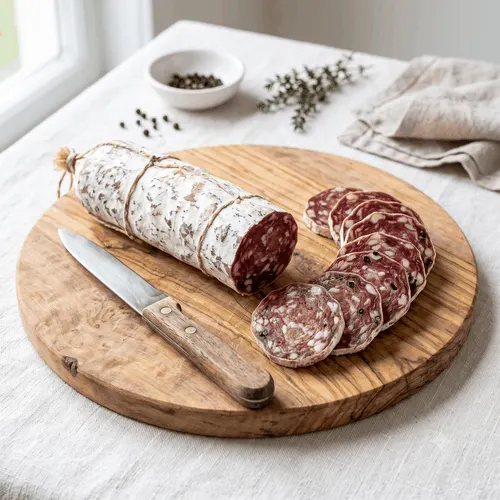
Other names saucisson sec, dry-cured sausage
Cured sausage: high in histamine and tyramine; moderate in salicylate; low in FODMAPs, gluten and nickel. If you're sensitive to any of these, check it against your profile before eating.
Intolerances
- Histamine (+liberators / DAO inhibitors)High
Cured sausage is fermented and then aged, and both stages produce amines. Surveys of fermented sausage find histamine and tyramine together, and the longer the drying the more of both. High microbial counts are what a fermented sausage IS, so amines accumulate — and great fluctuations are reported within a single type of product. Suzzi also records that no specific regulation covers these compounds in sausages, where fishery products have legal ceilings. An absence of limits is not a statement that the amounts are small.
Sources· 1
- Suzzi G et al., Int J Food Microbiol 88 (2003) 41-54, biogenic amines in dry fermented sausages
- TyramineHigh
Dry fermented sausage is the one tyramine food with a full probabilistic risk assessment behind it - 474 sausages against national consumption data - and that assessment exists precisely because the levels reach the range that matters for MAOI patients. Both the fermentation and the drying that follows add to it. A probabilistic estimate across 474 of these sausages puts a meal at 6.2 mg of tyramine and 1.39 mg of histamine on average — negligible risk for a healthy person, a 34 per cent chance of passing the MAOI threshold, and an estimated 7,000 people per million with histamine intolerance who could react.
Sources· 1
- Latorre-Moratalla M et al., Food Chem Toxicol 99 (2017) 78-85, tyramine and histamine exposure from dry fermented sausages
- SalicylateModerate
A cured sausage gets no salicylate from the meat; the pepper, paprika, garlic and herbs in the cure supply it. A plainly seasoned sausage sits lower than a heavily spiced one.
- FODMAPsLow
A cured sausage is meat and fat dried in its casing, and drying takes water out rather than putting fructan or lactose in. Garlic is the usual exception and it is on the label; a fresh sausage, by contrast, is often bulked with rusk or breadcrumb, which is wheat.
- GlutenPossible
Cured sausage is meat, fat, salt and spice - none of which carries gluten. What can is the binder: rusk, breadcrumb or wheat starch, used in some recipes and not others. What a label may promise is set by regulation and not by a recipe: 828/2014 allows "gluten-free" at or below 20 mg/kg, sets the conditions oats must meet, and admits wheat-derived ingredients in a gluten-free food provided the finished product stays under that ceiling. It measures nothing — it says what a food must meet to carry the claim, which is exactly what a food name cannot tell you.
Sources· 1
- Commission Implementing Regulation (EU) No 828/2014, the conditions for a gluten-free claim
- NickelLow
Cured sausage is meat, fat, salt and spice, dried in air. The nickel comes from the spice mix rather than the meat, which is why a heavily peppered sausage differs from a plain one. The nickel here follows a national survey covering four decades - the kind of series that shows whether a level is drifting, which a single study never can.
Sources· 1
- Jorhem L. et al., Livsmedelsverket rapport 28/2017, metals in Swedish foods over four decades
- LactoseFODMAPsNone
- FructoseFODMAPsNone
- OligosaccharidesFODMAPsNone
- SorbitolFODMAPsNone
- SucroseNone
- OxalatesNone
Intolerance levels are based on our documented scientific sources. See sources →
React to Histamine (+liberators / DAO inhibitors)? Check these too









More in Meat
Browse all foods →


Frequently asked questions
Which intolerances does cured sausage affect?
Cured sausage is notable for histamine, tyramine, salicylate, FODMAPs, gluten and nickel. Clear on lactose, fructose, oligosaccharides, sorbitol, sucrose and oxalates.
Does cured sausage contain histamine?
Yes — cured sausage is high in histamine. Cured sausage is fermented and then aged, and both stages produce amines. Surveys of fermented sausage find histamine and tyramine together, and the longer the drying the more of both. High microbial counts are what a fermented sausage IS, so amines accumulate — and great fluctuations are reported within a single type of product. Suzzi also records that no specific regulation covers these compounds in sausages, where fishery products have legal ceilings. An absence of limits is not a statement that the amounts are small.
Does cured sausage contain tyramine?
Yes — cured sausage is high in tyramine. Dry fermented sausage is the one tyramine food with a full probabilistic risk assessment behind it - 474 sausages against national consumption data - and that assessment exists precisely because the levels reach the range that matters for MAOI patients. Both the fermentation and the drying that follows add to it. A probabilistic estimate across 474 of these sausages puts a meal at 6.2 mg of tyramine and 1.39 mg of histamine on average — negligible risk for a healthy person, a 34 per cent chance of passing the MAOI threshold, and an estimated 7,000 people per million with histamine intolerance who could react.
Does cured sausage contain salicylate?
Cured sausage contains moderate levels of salicylate. A cured sausage gets no salicylate from the meat; the pepper, paprika, garlic and herbs in the cure supply it. A plainly seasoned sausage sits lower than a heavily spiced one.
Does cured sausage contain FODMAPs?
Cured sausage contains only low levels of FODMAPs. A cured sausage is meat and fat dried in its casing, and drying takes water out rather than putting fructan or lactose in. Garlic is the usual exception and it is on the label; a fresh sausage, by contrast, is often bulked with rusk or breadcrumb, which is wheat. Amounts vary by brand and recipe, so always check the label of the exact product.
Check any product in seconds
Scan a barcode with the Yllo app and see straight away whether a product fits your intolerances.