Broad bean
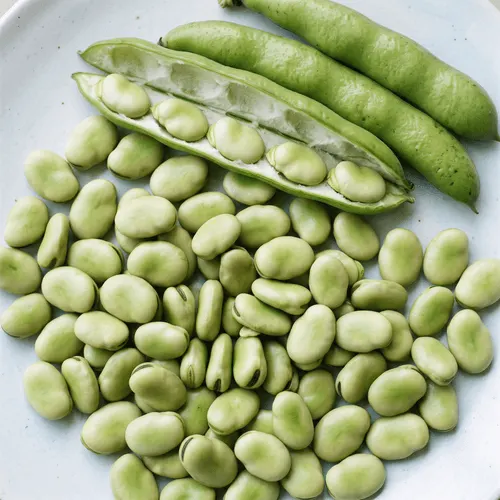
Other names fava bean, faba bean
Broad bean: high in tyramine, FODMAPs, oligosaccharides and nickel; moderate in oxalates; low in histamine, salicylate, fructose and sucrose. If you're sensitive to any of these, check it against your profile before eating.
Intolerances
- TyramineHigh
Broad bean: one of only four foods a monoamine oxidase inhibitor diet excludes outright, alongside aged cheese, yeast extract and sauerkraut. The compound is not tyramine but L-dopa, which the body turns into dopamine - a pressor amine cleared by the same enzyme and dangerous in the same way. It concentrates in the POD rather than the shelled bean, so podded and skinned beans measure far lower than whole young pods eaten as a vegetable. One caution belongs beside that restriction. McCabe-Sellers' review of the MAOI food lists argues that the early tyramine analyses no longer hold - methods, packaging, storage and handling have all changed - and that many of the old restrictions came from case reports without any analysis and were then over-extrapolated to whole categories. It publishes no measurement of its own, so it can rank foods and not value them; broad bean is one of the few that survived that narrowing.
Sources· 1
- McCabe-Sellers B.J. et al., J Food Compos Anal 19 (2006) S58-S65, tyramine in foods and monoamine oxidase inhibitor drugs
- FODMAPsHigh
Broad beans are a pulse, and pulses are the galacto-oligosaccharide group - chains humans have no enzyme to split, so they arrive in the colon intact and ferment. Soaking and discarding the water removes part of them; canned and rinsed measures lower than dried and boiled at home.
Sources· 1
- Tuck C et al., J Hum Nutr Diet 31 (2018), FODMAP content of common plant-based and processed foods
- OligosaccharidesFODMAPsHigh
Broad bean: the galacto-oligosaccharides of a pulse are the specific FODMAP at issue here - raffinose, stachyose and verbascose. They are water-soluble, which is the one useful fact: the soaking water carries them off, and throwing it away is worth doing. The pulse galacto-oligosaccharides are the measured part - Tuck's 2018 survey is what that rests on.
Sources· 1
- Tuck C et al., J Hum Nutr Diet 31 (2018), FODMAP content - legume galacto-oligosaccharides
- NickelHigh
Broad beans take nickel up the way every legume does - nickel is the cofactor of urease, the enzyme pulses need for nitrogen, so they draw it from the soil deliberately. Fresh and dried legumes sit together among the highest contents measured.
Sources· 1
- Flyvholm M-A et al., Z Lebensm Unters Forsch 179 (1984) 427-431, nickel content of food and estimates of dietary intake
- OxalatesModerate
Broad bean: pulses carry a moderate oxalate load, and cooking lowers it - boiling and draining takes soluble oxalate away with the water. That is measurable, and it is the reason a soaked and boiled bean differs from a raw one. Quinteros measured soluble oxalate in beans, chickpeas and lentils and found that every cooking method reduces it — the loss going into the water rather than disappearing.
Sources· 1
- Quinteros A et al., Int J Food Sci Nutr 54:5 (2003) 373-377, soluble oxalate in beans, chickpeas and lentils
- Histamine (+liberators / DAO inhibitors)Low
The broad bean is a fresh, unfermented seed, and it carries little histamine. Germination is the one preparation that changes it - a sprouting seed produces amines as it wakes up, so bean sprouts are a different food here from the pulse they came from. The pod is the part the MAOI literature names, and it names it for dopamine rather than for tyramine — Shulman's review is where the restriction was measured rather than repeated, and Gardner's later one kept broad bean PODS on the short list while dropping most of what surrounded them. That was measured on this bean rather than assumed: Shalaby followed broad bean, chick pea and lupine raw, germinated and cooked. Every amine tested was present in the ungerminated seed, tryptamine dominated and rose considerably with germination - and ON COOKING THE SEEDS BECAME FREE OF BIOGENIC AMINES, WHICH APPEARED IN THE BOILING WATER. Boil, drain, and do not keep the water.
Sources· 3
- Shulman K.I. et al., J Clin Psychopharmacol 9 (1989) 397-402, tyramine assayed in over 100 controversial foods
- Gardner D.M. et al., J Clin Psychiatry 57 (1996) 99-104, the review that narrowed the MAOI diet
- Shalaby A, Nahrung 44:1 (2000), 23-27, biogenic amines in mature and germinating legume seeds and during cooking
- SalicylateLow
Broad bean: pulses sit low on salicylate elimination lists. The pod is greener than the seed and carries a little more, which matters only if you eat young pods whole.
- FructoseFODMAPsLow
Broad bean is a starchy seed with very little free sugar, and what there is comes balanced rather than fructose-dominant - so glucose carries it across and no excess builds up.
- SucroseLow
Most of the carbohydrate here is starch, not sugar. Broad beans do carry a little sucrose, more in the young sweet pods than in the mature dried seed - which is the opposite of how their FODMAP load runs.
- SorbitolFODMAPsNone
- LactoseFODMAPsNone
- GlutenNo
Intolerance levels are based on our documented scientific sources. See sources →
React to Tyramine? Check these too








More in Nuts/Seeds
 Adzuki bean
 Almond
 Anise
Anise Beans
Beans Brazil nut
 Cashew nuts
 Channa dal
 Chia seed
 Chickpea
 Flax seed
 Ground hazelnuts
 Hazelnut
Frequently asked questions
Which intolerances does broad bean affect?
Broad bean is notable for tyramine, FODMAPs, oligosaccharides, nickel, oxalates, histamine, salicylate, fructose and sucrose. Clear on sorbitol, lactose and gluten.
Does broad bean contain tyramine?
Yes — broad bean is high in tyramine. Broad bean: one of only four foods a monoamine oxidase inhibitor diet excludes outright, alongside aged cheese, yeast extract and sauerkraut. The compound is not tyramine but L-dopa, which the body turns into dopamine - a pressor amine cleared by the same enzyme and dangerous in the same way. It concentrates in the POD rather than the shelled bean, so podded and skinned beans measure far lower than whole young pods eaten as a vegetable. One caution belongs beside that restriction. McCabe-Sellers' review of the MAOI food lists argues that the early tyramine analyses no longer hold - methods, packaging, storage and handling have all changed - and that many of the old restrictions came from case reports without any analysis and were then over-extrapolated to whole categories. It publishes no measurement of its own, so it can rank foods and not value them; broad bean is one of the few that survived that narrowing.
Does broad bean contain FODMAPs?
Yes — broad bean is high in FODMAPs. Broad beans are a pulse, and pulses are the galacto-oligosaccharide group - chains humans have no enzyme to split, so they arrive in the colon intact and ferment. Soaking and discarding the water removes part of them; canned and rinsed measures lower than dried and boiled at home.
Does broad bean contain oligosaccharides?
Yes — broad bean is high in oligosaccharides. Broad bean: the galacto-oligosaccharides of a pulse are the specific FODMAP at issue here - raffinose, stachyose and verbascose. They are water-soluble, which is the one useful fact: the soaking water carries them off, and throwing it away is worth doing. The pulse galacto-oligosaccharides are the measured part - Tuck's 2018 survey is what that rests on.
Does broad bean contain nickel?
Yes — broad bean is high in nickel. Broad beans take nickel up the way every legume does - nickel is the cofactor of urease, the enzyme pulses need for nitrogen, so they draw it from the soil deliberately. Fresh and dried legumes sit together among the highest contents measured. Amounts vary by brand and recipe, so always check the label of the exact product.
Check any product in seconds
Scan a barcode with the Yllo app and see straight away whether a product fits your intolerances.