Roquefort
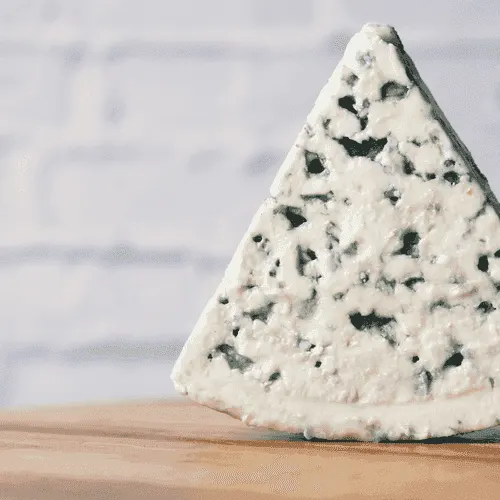
Other names roquefort cheese, Roquefort cheese from ewe's milk
Roquefort: high in histamine and tyramine; low in oxalates and gluten. If you're sensitive to any of these, check it against your profile before eating.
Intolerances
- Histamine (+liberators / DAO inhibitors)High
Roquefort stacks three things that each raise the level: sheep's milk, richer in protein than cow's; Penicillium roqueforti grown right through the paste; and the ageing its AOP requires - fourteen days at least in the Combalou caves and three months in all before it may be sold, usually longer. It is habitually cited among the highest-histamine cheeses measured. That ageing is a floor and not a typical age: the wheel in front of you may be far past it.
Sources· 4
- AOP and DOP specifications of the cheeses named, for the minimum ageing
- Fox PF, Cheese - Chemistry, Physics and Microbiology, vol. 1
- McCabe-Sellers et al., J Food Compos Anal 2006
- Maintz & Novak, Am J Clin Nutr 2007
- TyramineHigh
Roquefort stacks three things that each raise tyramine: sheep's milk, richer in protein than cow's; Penicillium grown right through the paste rather than on the rind; and the ageing its AOP requires - at least fourteen days in the Combalou caves and three months in all before it may be sold, usually more. It is habitually cited among the highest cheeses measured.
Sources· 3
- AOP and DOP specifications of the cheeses named, for the minimum ageing
- EFSA Panel on Biological Hazards, EFSA Journal 2011
- McCabe-Sellers et al., J Food Compos Anal 2006
- OxalatesLow
Roquefort contains no oxalate of its own - oxalate is a plant compound and this is not a plant. The blue veins are mould grown in the curd, fed on milk, not on plants. On the board, the bread and the nuts are what this axis has to count. Its calcium even helps the rest of the plate: it binds oxalate from whatever is eaten alongside.
Sources· 1
- Jaeger Ph. et al., Nephron Physiol 98 (2004) 64-71, dietary intake and intestinal absorption of oxalate
- GlutenPossible
Roquefort is made in caves rather than in a laboratory, and the traditional method really did grow the Penicillium on rye bread left in the cave. Modern producers use cultured spores, and cheese is on Coeliac UK's naturally gluten-free list — which is the whole of what is published, since no dosage of Roquefort exists either way. This is the one blue where the story is not a myth, only history.
Sources· 5
- Coeliac UK — gluten free diet guidance: “All spirits are distilled during the manufacturing process and this process removes any trace of gluten”
- beer, lagers, stouts and ales not suitable
- gluten free beer at or below 20 ppm
- barley malt vinegar to be both tested and labelled gluten free
- Regulation (EU) No 1169/2011, Annex II
- SalicylateNone
- SucroseNone
- FODMAPsNone
- LactoseFODMAPsNone
- OligosaccharidesFODMAPsNone
- SorbitolFODMAPsNone
- FructoseFODMAPsNone
- NickelNone
Intolerance levels are based on our documented scientific sources. See sources →
React to Histamine (+liberators / DAO inhibitors)? Check these too








More in Dairy
 Blue cheese
 Brie
Brie Buffalo mozzarella
 Buttermilk
 Camembert
 Casein
 Cheddar
 Cream
Cream- Cream cheese
 Crème fraîche
 Edam
Edam- Emmental
Frequently asked questions
Which intolerances does roquefort affect?
Roquefort is notable for histamine, tyramine, oxalates and gluten. Clear on salicylate, sucrose, FODMAPs, lactose, oligosaccharides, sorbitol, fructose and nickel.
Does roquefort contain histamine?
Yes — roquefort is high in histamine. Roquefort stacks three things that each raise the level: sheep's milk, richer in protein than cow's; Penicillium roqueforti grown right through the paste; and the ageing its AOP requires - fourteen days at least in the Combalou caves and three months in all before it may be sold, usually longer. It is habitually cited among the highest-histamine cheeses measured. That ageing is a floor and not a typical age: the wheel in front of you may be far past it.
Does roquefort contain tyramine?
Yes — roquefort is high in tyramine. Roquefort stacks three things that each raise tyramine: sheep's milk, richer in protein than cow's; Penicillium grown right through the paste rather than on the rind; and the ageing its AOP requires - at least fourteen days in the Combalou caves and three months in all before it may be sold, usually more. It is habitually cited among the highest cheeses measured.
Does roquefort contain oxalates?
Roquefort contains only low levels of oxalates. Roquefort contains no oxalate of its own - oxalate is a plant compound and this is not a plant. The blue veins are mould grown in the curd, fed on milk, not on plants. On the board, the bread and the nuts are what this axis has to count. Its calcium even helps the rest of the plate: it binds oxalate from whatever is eaten alongside.
Does roquefort contain gluten?
Roquefort contains only low levels of gluten. Roquefort is made in caves rather than in a laboratory, and the traditional method really did grow the Penicillium on rye bread left in the cave. Modern producers use cultured spores, and cheese is on Coeliac UK's naturally gluten-free list — which is the whole of what is published, since no dosage of Roquefort exists either way. This is the one blue where the story is not a myth, only history. Amounts vary by brand and recipe, so always check the label of the exact product.
Check any product in seconds
Scan a barcode with the Yllo app and see straight away whether a product fits your intolerances.