Croissant
Other names Hörnchen
Croissant: high in gluten; moderate in FODMAPs and oligosaccharides; low in lactose, histamine, sucrose, nickel and oxalates. If you're sensitive to any of these, check it against your profile before eating.
Intolerances
- GlutenContains
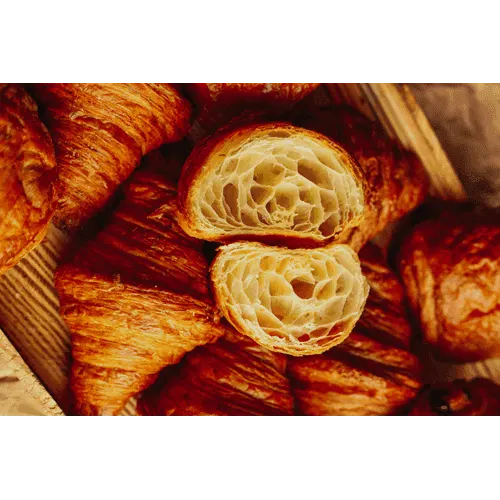
A croissant is wheat flour laminated with butter, and the lamination depends on gluten - it is the protein network that holds the layers apart as they rise. There is no version of the technique without it.
Sources· 1
- Regulation (EU) No 1169/2011, Annex II, the fourteen allergens requiring declaration
- FODMAPsModerate
A croissant is mostly butter and air by volume, so the flour weight is lower than its size suggests - and butter carries no FODMAP worth counting. One small croissant is often manageable; the pain au raisin next to it is not, because the raisins bring their own load. This food is not among the 55 grain products behind this axis's per-portion figures, so its level is a placing and not a measurement.
Sources· 3
- Tuck C et al., J Hum Nutr Diet 31 (2018), FODMAP content of common plant-based and processed foods
- Biesiekierski J et al., J Hum Nutr Diet 24 (2011) 154-176, fructans and galacto-oligosaccharides per portion as eaten
- USDA FoodData Central, the national nutrient database, queried for the sugar profile
- OligosaccharidesFODMAPsModerate
Croissant: same reason as the FODMAP level: wheat fructans, in a pastry that is mostly butter and air by volume. Fat carries no chains, so the flour weight is what counts and it is lower than the size suggests.
- LactoseFODMAPsLow
A croissant does not hide its dairy - it is made of it. Butter is most of the recipe by reputation, but butter is nearly all fat and carries very little lactose; the milk in the dough is where the sugar actually is.
Sources· 3
- Regulation (EU) No 1169/2011, Annex II, which requires milk to be declared as an allergen
- USDA FoodData Central
- Schweizer Nährwertdatenbank v6.3 (2021), Bundesamt für Lebensmittelsicherheit, consulted as a third lactose reading
- Histamine (+liberators / DAO inhibitors)Low
Croissant is low because it is a short-risen dough, baked before anything accumulates. Baking and drying are the two processes that end the amine question rather than starting it - heat kills the bacteria and dryness stops the rest. A sourdough proved for two days is the counter-example.
Sources· 1
- SIGHI — Swiss Interest Group Histamine Intolerance, food-compatibility list, for the entry, its rating and its letters
- SucroseLow
A croissant carries sugar in the dough, but far less than a pastry - the richness comes from butter, not from sweetening. A pain au chocolat is a different answer.
Sources· 1
- USDA FoodData Central, the national nutrient database, queried for the sugar profile
- NickelLow
A croissant is refined flour and butter. Both are low, and the butter is genuinely empty - fat carries almost no metal at all.
Sources· 1
- Cabrera-Vique C. et al., Sci Total Environ 409 (2011) 1584-1588, nickel in convenience and fast foods and its dialysable fraction
- OxalatesLow
A croissant is refined wheat flour and butter - the milling took the bran and germ, and the lamination adds fat, not plant fibre. The oxalate a wholemeal loaf would carry is simply not in the dough.
Sources· 1
- Noonan S.C. & Savage G.P., Asia Pac J Clin Nutr 8:1 (1999) 64-74, oxalate content of foods and its effect on humans
- FructoseFODMAPsNone
- SorbitolFODMAPsNone
- TyramineNone
- SalicylateNone
Intolerance levels are based on our documented scientific sources. See sources →
React to Gluten? Check these too




More in Other
 Almond butter
 Almond cream
 Almond yogurt
 Apple puree
 Beef broth
 Beef gelatin
 Beetroot juice powder
 Bouillon cube
 Breadcrumbs
 Calcium
 Cashew cheese
 Chicken broth
Frequently asked questions
Which intolerances does Croissant affect?
Croissant is notable for gluten, FODMAPs, oligosaccharides, lactose, histamine, sucrose, nickel and oxalates. Clear on fructose, sorbitol, tyramine and salicylate.
Does Croissant contain gluten?
Yes — Croissant is high in gluten. A croissant is wheat flour laminated with butter, and the lamination depends on gluten - it is the protein network that holds the layers apart as they rise. There is no version of the technique without it.
Does Croissant contain FODMAPs?
Croissant contains moderate levels of FODMAPs. A croissant is mostly butter and air by volume, so the flour weight is lower than its size suggests - and butter carries no FODMAP worth counting. One small croissant is often manageable; the pain au raisin next to it is not, because the raisins bring their own load. This food is not among the 55 grain products behind this axis's per-portion figures, so its level is a placing and not a measurement.
Does Croissant contain oligosaccharides?
Croissant contains moderate levels of oligosaccharides. Croissant: same reason as the FODMAP level: wheat fructans, in a pastry that is mostly butter and air by volume. Fat carries no chains, so the flour weight is what counts and it is lower than the size suggests.
Does Croissant contain lactose?
Croissant contains only low levels of lactose. A croissant does not hide its dairy - it is made of it. Butter is most of the recipe by reputation, but butter is nearly all fat and carries very little lactose; the milk in the dough is where the sugar actually is. Amounts vary by brand and recipe, so always check the label of the exact product.
Check any product in seconds
Scan a barcode with the Yllo app and see straight away whether a product fits your intolerances.