Tomato sauce
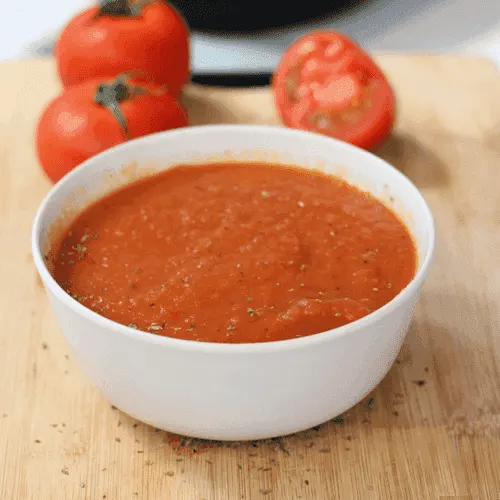
Other names Sauce tomate, Tomato passata
Tomato sauce: high in histamine; moderate in FODMAPs, oligosaccharides and salicylate; low in gluten, fructose, sucrose, tyramine, nickel and oxalates. If you're sensitive to any of these, check it against your profile before eating.
Intolerances
- Histamine (+liberators / DAO inhibitors)High
Tomato sauce is tomato reduced for an hour and then kept - and both halves matter: the reduction concentrates the histamine that was there, and a jar or a pan kept in the fridge for days keeps building. A sauce made and eaten the same evening is a different food from the half-jar at the back of the shelf.
Sources· 2
- Maintz & Novak, Am J Clin Nutr 2007
- Comas-Baste et al., Biomolecules 2020
- FODMAPsModerate
Tomato sauce is cooked-down tomato, and cooking concentrates the FODMAP sugars while removing nothing. Half a cup is around the limit for a plain passata; a jarred sauce with onion and garlic in it is a different food and a different answer.
Sources· 2
- Tuck C et al., J Hum Nutr Diet 31 (2018), FODMAP content of common plant-based and processed foods
- USDA FoodData Central, the national nutrient database, queried for the sugar profile
- OligosaccharidesFODMAPsModerate
The tomato is not the issue on this axis - tomato brings sugar, not chains. What puts a jarred sauce here is the onion and garlic cooked into it, which is why a plain passata and a ready-made sauce are not the same food. This is a PREPARED food, and that is the difficulty on this axis: the oligosaccharides come from whatever went in - onion, garlic, a legume, an added fibre - not from a single plant that could be looked up. The level follows work on fructooligosaccharides in prepared and preserved foods for that reason. The survey behind this ranks by PLANT FAMILY rather than by food: the Compositae highest in total fructooligosaccharide, then the Allium species. A prepared food takes its place from whichever of those went into it - onion and garlic are Allium, artichoke and chicory are Compositae - and the survey names no prepared food itself.
Sources· 2
- Hogarth A. et al., J Agric Food Chem 48 (2000), fructooligosaccharides in prepared and preserved foods
- Campbell J.M. et al., J Agric Food Chem 45 (1997) 3076-3082, fructooligosaccharide composition of foods and feeds
- SalicylateModerate
Reducing tomatoes into sauce boils off water and concentrates the salicylate, so a portion of sauce carries more than the fresh tomatoes it took to make it.
Sources· 1
- Duthie G.G. & Wood A.D., Food Funct 2 (2011) 515-520, natural salicylates in foods
- GlutenPossible
Tomato sauce is tomato, and tomato has no gluten - but a jarred pasta sauce is often thickened with wheat flour or carries a 'may contain' line from a factory that also makes filled pasta. A plain passata with one ingredient does not.
Sources· 2
- Regulation (EU) No 1169/2011, Annex II
- Commission Implementing Regulation (EU) No 828/2014 (gluten-free at or below 20 mg/kg)
- FructoseFODMAPsLow
Tomato sauce carries the tomato's own small fructose load, and many commercial jars add sugar on top to balance the acidity. Passata without added sugar is lower.
Sources· 1
- USDA FoodData Central, the national nutrient database, queried for the sugar profile
- SucroseLow
Tomato sauce carries the tomato's own small sucrose share, and many jars add sugar to balance the acidity - which is why an own-brand passata and a premium jarred sauce can differ several-fold.
Sources· 1
- USDA FoodData Central, the national nutrient database, queried for the sugar profile
- TyramineLow
Tomato sauce is cooked tomato, where heat ends any bacterial activity. Tyramine needs three things - protein, bacteria and time - and a cooked or dried product has had the second removed and the third stopped.
Sources· 1
- Sen N.P., Journal of Food Science 34 (1969) 22-26, per-food tyramine content
- NickelLow
Tomato sauce is cooked tomato, usually in a can. Acid plus heat plus metal is the combination that transfers most, and this is the food where it happens most often.
Sources· 1
- Cabrera-Vique C. et al., Sci Total Environ 409 (2011) 1584-1588, nickel in convenience and fast foods and its dialysable fraction
- OxalatesLow
Tomato sauce concentrates tomato, and the tomato's oxalate concentrates with it. Tomato sauce is eaten as a plate-sized portion rather than a spoonful, which is what makes the concentration count here.
Sources· 1
- Noonan S.C. & Savage G.P., Asia Pac J Clin Nutr 8:1 (1999) 64-74, oxalate content of foods and its effect on humans
- LactoseFODMAPsNone
- SorbitolFODMAPsNone
Intolerance levels are based on our documented scientific sources. See sources →
React to Histamine (+liberators / DAO inhibitors)? Check these too









More in Other
 Almond butter
 Almond cream
 Almond yogurt
 Apple puree
 Beef broth
 Beef gelatin
 Beetroot juice powder
 Bouillon cube
 Breadcrumbs
 Calcium
 Cashew cheese
 Chicken broth
Frequently asked questions
Which intolerances does Tomato sauce affect?
Tomato sauce is notable for histamine, FODMAPs, oligosaccharides, salicylate, gluten, fructose, sucrose, tyramine, nickel and oxalates. Clear on lactose and sorbitol.
Does Tomato sauce contain histamine?
Yes — Tomato sauce is high in histamine. Tomato sauce is tomato reduced for an hour and then kept - and both halves matter: the reduction concentrates the histamine that was there, and a jar or a pan kept in the fridge for days keeps building. A sauce made and eaten the same evening is a different food from the half-jar at the back of the shelf.
Does Tomato sauce contain FODMAPs?
Tomato sauce contains moderate levels of FODMAPs. Tomato sauce is cooked-down tomato, and cooking concentrates the FODMAP sugars while removing nothing. Half a cup is around the limit for a plain passata; a jarred sauce with onion and garlic in it is a different food and a different answer.
Does Tomato sauce contain oligosaccharides?
Tomato sauce contains moderate levels of oligosaccharides. The tomato is not the issue on this axis - tomato brings sugar, not chains. What puts a jarred sauce here is the onion and garlic cooked into it, which is why a plain passata and a ready-made sauce are not the same food. This is a PREPARED food, and that is the difficulty on this axis: the oligosaccharides come from whatever went in - onion, garlic, a legume, an added fibre - not from a single plant that could be looked up. The level follows work on fructooligosaccharides in prepared and preserved foods for that reason. The survey behind this ranks by PLANT FAMILY rather than by food: the Compositae highest in total fructooligosaccharide, then the Allium species. A prepared food takes its place from whichever of those went into it - onion and garlic are Allium, artichoke and chicory are Compositae - and the survey names no prepared food itself.
Does Tomato sauce contain salicylate?
Tomato sauce contains moderate levels of salicylate. Reducing tomatoes into sauce boils off water and concentrates the salicylate, so a portion of sauce carries more than the fresh tomatoes it took to make it. Amounts vary by brand and recipe, so always check the label of the exact product.
Check any product in seconds
Scan a barcode with the Yllo app and see straight away whether a product fits your intolerances.