Whisky
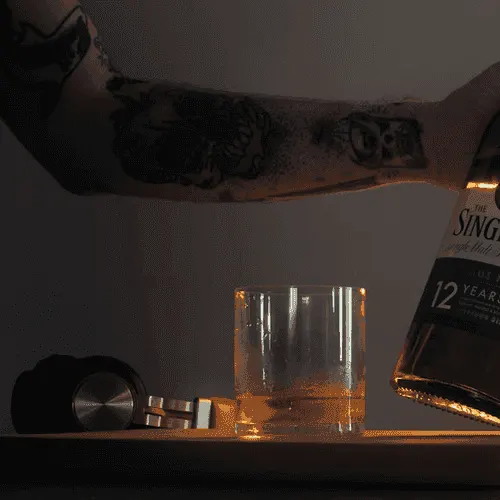
Other names whiskey, scotch
Whisky: moderate in histamine and salicylate; low in gluten. If you're sensitive to any of these, check it against your profile before eating.
Intolerances
- Histamine (+liberators / DAO inhibitors)Moderate
Whisky is aged in oak for three years at minimum and commonly ten or more, and unlike cognac it is often matured in casks that previously held sherry or bourbon - a second history in the same barrel, and more time for the amines. Longer in wood is more of what the distillation removed, on top of the alcohol.
Sources· 2
- Maintz & Novak, Am J Clin Nutr 2007
- Comas-Baste et al., Biomolecules 2020
- SalicylateModerate
Whisky is distilled grain, which carries little salicylate, but oak ageing adds some back, and the alcohol itself worsens tolerance to everything else eaten with it. Neither study publishes a value for this particular drink.
Sources· 2
- Duthie G.G. & Wood A.D., Food Funct 2 (2011) 515-520, natural salicylates in foods
- Scotter M.J. et al., Food Chem 105 (2007) 273-279, and Venema D. et al., J Agric Food Chem 44 (1996) 1762-1767
- GlutenPossible
Whisky is distilled from barley and is nonetheless gluten-free - the protein stays in the still and the cask adds nothing back. Coeliac societies list it as suitable. What is not covered is a flavoured or cask-finished bottling where something was added after distillation. The law says it in one line, and the line is worth quoting: Annex II exempts 'cereals used for making alcoholic distillates including ethyl alcohol of agricultural origin' from the gluten declaration. An exemption is a judgement about the process, not a measurement of the bottle - which is why what is added AFTER distillation is still the open question.
Sources· 5
- Coeliac UK — gluten free diet guidance: “All spirits are distilled during the manufacturing process and this process removes any trace of gluten”
- beer, lagers, stouts and ales not suitable
- gluten free beer at or below 20 ppm
- barley malt vinegar to be both tested and labelled gluten free
- Regulation (EU) No 1169/2011, Annex II
- TyramineNone
- SucroseNone
- FODMAPsNone
- LactoseFODMAPsNone
- OligosaccharidesFODMAPsNone
- SorbitolFODMAPsNone
- FructoseFODMAPsNone
- NickelNone
- OxalatesNone
Intolerance levels are based on our documented scientific sources. See sources →
React to Histamine (+liberators / DAO inhibitors)? Check these too






More in Drinks
 Advocaat
 Alcohol
 Alcohol free beer
 Almond Milk
 Apple juice concentrate
- Beer
 Black tea
- Cashew milk
 Champagne
- Coconut Milk
 Coconut water
 Coffee
Frequently asked questions
Which intolerances does whisky affect?
Whisky is notable for histamine, salicylate and gluten. Clear on tyramine, sucrose, FODMAPs, lactose, oligosaccharides, sorbitol, fructose, nickel and oxalates.
Does whisky contain histamine?
Whisky contains moderate levels of histamine. Whisky is aged in oak for three years at minimum and commonly ten or more, and unlike cognac it is often matured in casks that previously held sherry or bourbon - a second history in the same barrel, and more time for the amines. Longer in wood is more of what the distillation removed, on top of the alcohol.
Does whisky contain salicylate?
Whisky contains moderate levels of salicylate. Whisky is distilled grain, which carries little salicylate, but oak ageing adds some back, and the alcohol itself worsens tolerance to everything else eaten with it. Neither study publishes a value for this particular drink.
Does whisky contain gluten?
Whisky contains only low levels of gluten. Whisky is distilled from barley and is nonetheless gluten-free - the protein stays in the still and the cask adds nothing back. Coeliac societies list it as suitable. What is not covered is a flavoured or cask-finished bottling where something was added after distillation. The law says it in one line, and the line is worth quoting: Annex II exempts 'cereals used for making alcoholic distillates including ethyl alcohol of agricultural origin' from the gluten declaration. An exemption is a judgement about the process, not a measurement of the bottle - which is why what is added AFTER distillation is still the open question. Amounts vary by brand and recipe, so always check the label of the exact product.
Check any product in seconds
Scan a barcode with the Yllo app and see straight away whether a product fits your intolerances.